Underfloor Heating Maintenance in MK: Why Hard Water Matters
TL;DR
Wet underfloor heating has no moving parts in the floor, but Milton Keynes water is very hard, and limescale and iron sludge build up faster in narrow UFH pipe than in radiators. Three things keep a system healthy: an annual check at the manifold, keeping the corrosion inhibitor topped up, and a magnetic filter on the return. Watch for zones that warm slowly, uneven floor temperature, a falling pressure gauge and dark water at the manifold.
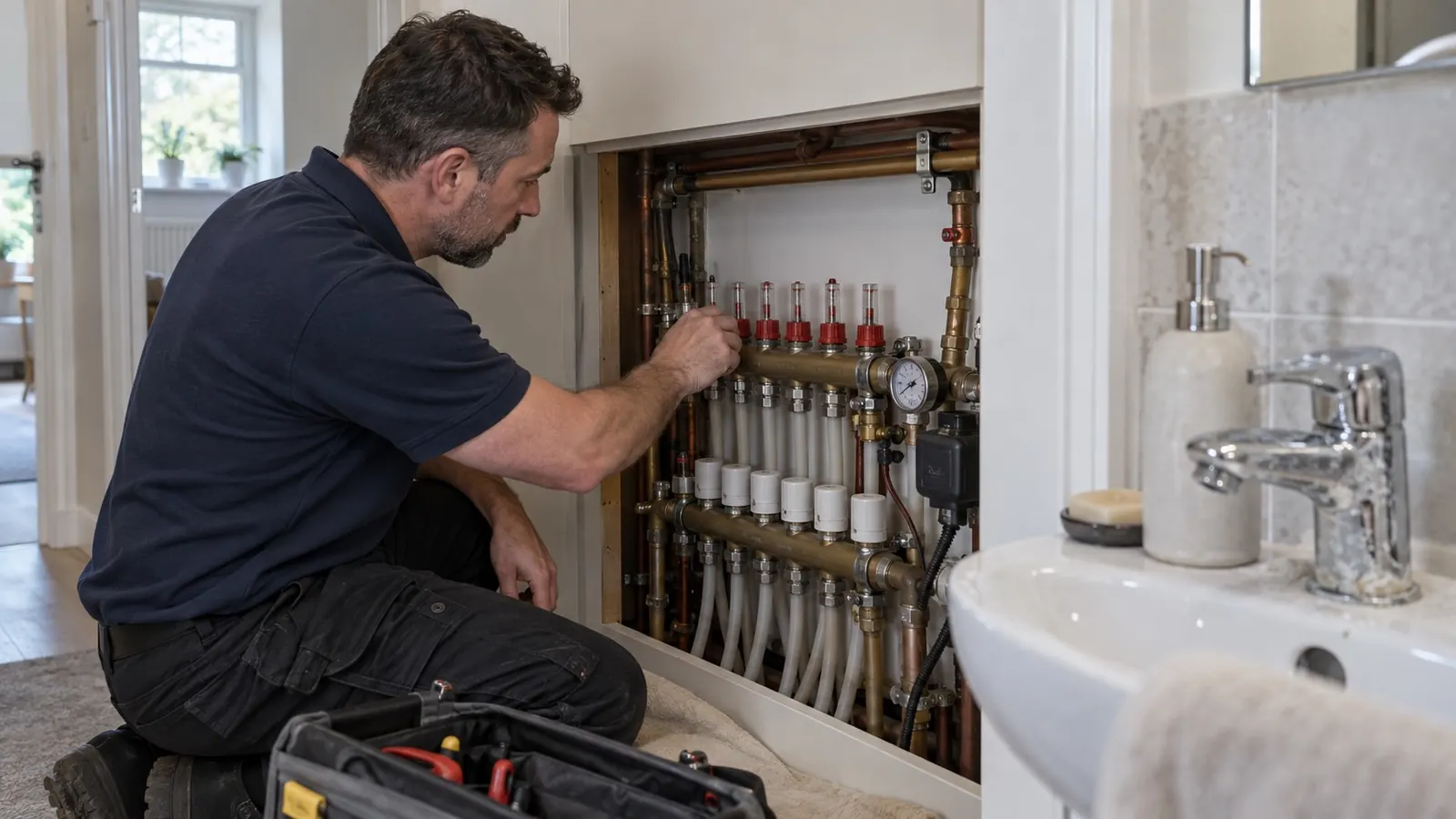
Underfloor heating is sold as fit and forget, and to be fair it mostly is. The pipe in the floor has no moving parts, the screed never needs touching, and a properly installed circuit can outlast the boiler that feeds it several times over. But it is not maintenance-free, and Milton Keynes water makes it vulnerable to the two things that do go wrong: limescale and magnetite sludge. This guide covers what actually needs looking after, how often, and what a UFH service involves.
One note first. The UFH pipework and manifold are plumbing. The boiler that heats it is a gas appliance, and any work on that is a Gas Safe registered engineer's job.
Why hard water matters more for UFH than for radiators
Anglian Water classes the supply across Milton Keynes as very hard. Heated hard water drops limescale on hot surfaces, and the same wet system slowly generates black iron oxide sludge as steel and iron parts corrode. In a radiator system you notice this: cold patches at the bottom of radiators, a labouring pump, a kettling boiler.
In an underfloor system the symptoms hide. The pipe in the floor is a much narrower bore than radiator pipework and runs in long loops, so a layer of scale or sludge that would barely trouble a radiator restricts a UFH loop noticeably. The flow drops, the room takes longer to warm, and most people put it down to the weather. By the time a zone clearly is not working, the loop may have years of deposit in it and cleaning it is far harder than it would have been. UFH here needs preventative maintenance, not reactive.
The three things that actually matter
An annual check at the manifold. Ideally before the heating season. The engineer checks that the flow meters on each loop read sensible, consistent values and match what they read last year; that there are no weeps at the compression fittings, the zone valves or the pump unions; that each actuator opens and closes when its thermostat calls; that the blending valve is still set to the design temperature the system was commissioned at; that the pump runs quietly; and that the system pressure has held. It is a short visit and it catches most problems while they are still cheap.
Inhibitor kept up. Corrosion inhibitor in the system water suppresses both sludge formation and scale. It depletes over time and it is lost every time the system is drained or topped up. The inhibitor level should be tested at each annual check and re-dosed when it is low, and always after any drain-down. Dosing means drawing off some water, adding the right product through the manifold, refilling and re-pressurising, so it is an engineer's job rather than a bottle poured in.
A magnetic filter on the return. Fitted on the pipe returning to the boiler, it captures magnetite before it can travel round and settle in the loops. It is emptied at every annual boiler service. If your UFH system does not have one, fitting one is the single best thing you can do for it, and it costs a fraction of clearing a blocked loop later.
Signs your UFH needs attention
- One zone takes noticeably longer to warm than the others, or never quite gets there.
- Uneven floor warmth across one room, warm near the manifold end of the loop and cool at the far end.
- The manifold pump is louder or hotter than it used to be.
- The pressure gauge drops over a heating season without anyone bleeding anything.
- Dark or rusty water when the manifold is bled or a loop is drained. It should run clear.
- Heating bills creeping up with no change in how you use the house.
Any of these is worth a call. Caught at this stage the fix is usually an inhibitor re-dose and a filter clean. Left for a few more winters it can mean a flush of the whole system with UFH-specific equipment, or in the worst case a loop that cannot be recovered.
What a UFH service covers
A proper UFH service, as distinct from a glance at the manifold, includes the manifold checks above, a test of the inhibitor concentration, cleaning the magnetic filter, a check of the boiler's flow temperature against what the UFH needs, and a check that the room thermostats and any wiring centre are calling the right zones. Where the system is run from a combi, the engineer should also check the blending valve and pump arrangement, which is where many retrofit installations go wrong. Our guide to running wet UFH from a combi boiler goes into that.
Combining the UFH check with the annual boiler service is the sensible way to do it: one visit in the autumn, both jobs done, one set of records.
Does UFH need a powerflush?
Sometimes, and it is not the same job as flushing radiators. UFH loops are flushed one at a time through the manifold at controlled flow, with the cleaning chemical given time to work, because forcing radiator-flush velocities through narrow pipe achieves little and can disturb fittings. If a system in Milton Keynes has run for many years with no filter and no inhibitor, a flush is often the only way to recover the flow. If it has been looked after, most systems never need one. The honest answer, which a company selling flushes will not give you, is that a filter and an annual inhibitor test cost far less than a flush and make the flush unnecessary for most homes.
What you can do yourself
Fine to do: look over the manifold for weeps and note any staining, read the flow meters and write the values down once a year so you can spot a change, set the room thermostats and check each zone responds, and check the pressure gauge on the boiler.
Leave to an engineer: dosing inhibitor, adjusting flow rates or the blending valve, servicing or replacing the pump or actuators, fitting a magnetic filter, flushing, and anything on the boiler.
If you are moving into a Milton Keynes house with existing underfloor heating and no service records, book a full check in the first year. Deposits that have built up under previous neglect can be dealt with cheaply now or expensively later.
UFH maintenance across Milton Keynes
Plumbline MK carries out underfloor heating inspections, maintenance and repairs across Milton Keynes and the surrounding towns, including Newport Pagnell, Bletchley, Wolverton, Stony Stratford, Woburn Sands, Olney, Buckingham and Bedford. We work on systems from Polypipe, Nu-Heat, Uponor, Wunda and others, and we can combine the UFH check with your boiler service. We are Gas Safe registered (957816). Get in touch to book.
Frequently asked questions
How often should underfloor heating be serviced?
Once a year, at the same time as the boiler service. The manifold is checked, the inhibitor tested, the filter cleaned and the flow rates compared with the previous year. In a very hard water area like Milton Keynes skipping this shortens the life of the system noticeably.
Can I add inhibitor to underfloor heating myself?
It is better done by an engineer. The right product and quantity depend on the system volume, and it has to go in through the manifold with the system partly drained and then re-pressurised. Done wrong it does nothing; done right it protects the pipe for years.
Why is one room with underfloor heating colder than the others?
Usually restricted flow in that loop: an actuator not opening fully, a flow meter set too low, air in the loop, or sludge and scale in the pipe. The manifold checks tell you which. If the loop has sludge, it needs flushing rather than turning the thermostat up.
Does hard water damage underfloor heating pipe?
Not the plastic pipe itself. The damage is the scale and sludge that hard water helps create, which restrict the flow inside the pipe, and the scale that forms on the pump, the blending valve and the boiler heat exchanger. Inhibitor, a magnetic filter and an annual check deal with all of it.
Need Professional Advice?
Our Gas Safe registered engineers are ready to help with all your heating needs. Get a free, no-obligation quote today.