How Long Does a Boiler Last?
TL;DR
A gas boiler that is serviced every year usually lasts 10 to 15 years, and a well-installed one in a clean system can go beyond that. The things that cut it short are skipped servicing, limescale in hard-water areas, sludge in the radiators and a poor original installation. Once a boiler is past 12 years old, breaking down more than once a year, or needs a major part like a heat exchanger, replacement usually makes more sense than repair.
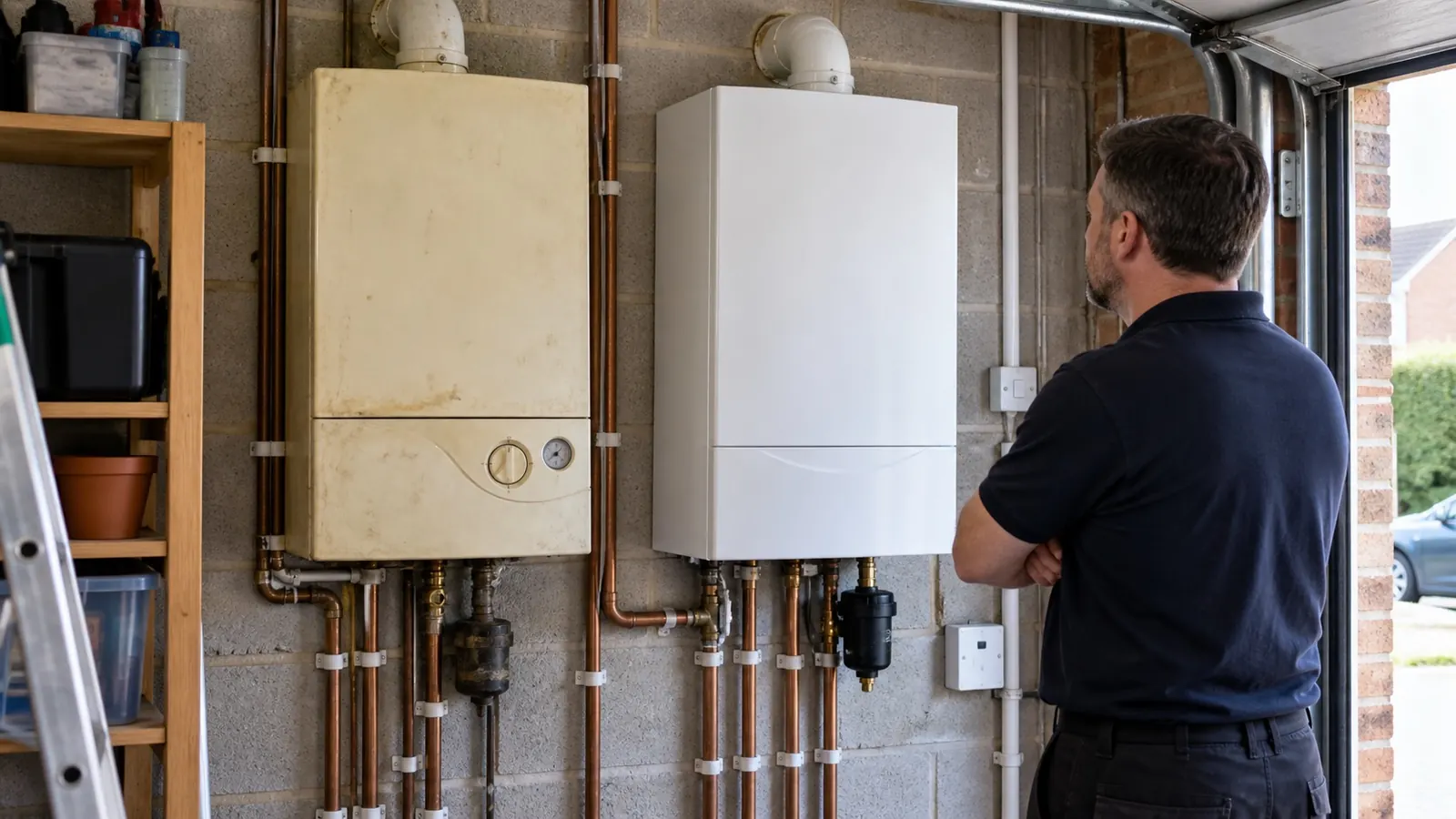
It is the question we get asked on nearly every service: how much longer has this got? The honest answer is that it varies more than people expect. Two identical boilers fitted on the same street in the same month can be ten years apart in how long they survive, and the difference nearly always comes down to how they were installed and how they have been looked after since.
The typical lifespan
A modern condensing gas boiler that is serviced annually should give you 10 to 15 years of dependable service. Some go well past that. We still service boilers from the late 2000s that run perfectly because they were fitted onto a clean system with a filter and have been serviced every year since.
In practice many boilers are replaced somewhere around the 12 to 15 year mark, and not always because they have died. Three things push people towards replacing a boiler that still technically works:
- Repairs get more frequent. One call-out a year turns into two or three.
- Parts get harder to find. Manufacturers support a model for a period after it is discontinued, then stocks of certain boards and fans dry up.
- Efficiency drops. A boiler fitted before 2005 is probably not a condensing model at all, and even an early condensing boiler with a scaled-up heat exchanger is not running at the figure on its label.
What shortens a boiler's life
If a boiler is struggling well before the ten-year mark, one or more of these is usually behind it.
1. Missed services
This is the big one. An annual service is when worn parts get spotted, the condensate trap gets cleaned, the combustion gets checked and the small fault gets fixed before it becomes the big one. A boiler that is never serviced does not fail gracefully; it fails in January. Missing services also voids most manufacturer warranties, so the one time you would have been covered, you are not.
2. Hard water and limescale
Milton Keynes sits on chalk-fed water and it is among the hardest in the country. On a combi, every litre of hot water you draw passes through the plate heat exchanger, and every litre leaves a trace of scale behind. Over years that scale narrows the waterways, makes the boiler run hotter to deliver the same heat, and eventually cracks or blocks the exchanger, which is one of the most expensive parts on the boiler. A scale reducer on the incoming main is a cheap defence and we would fit one on any new boiler here.
3. Sludge in the system
Black iron oxide builds up in radiators and pipework as the steel corrodes from the inside. It settles in the bottom of radiators, clogs the pump and gets carried into the boiler's heat exchanger. Signs are radiators cold at the bottom and warm at the top, a noisy pump and a boiler that kettles. A magnetic filter catches most of it, and a powerflush clears a system that is already full of it. Inhibitor in the water slows the corrosion in the first place. Systems without any of these three things wear their boilers out early.
4. A poor original installation
An oversized boiler cycles on and off constantly, which is hard on the fan, the ignition and the gas valve. A system that was never flushed when the boiler went in starts its life dirty. Pipework run without proper support or with the wrong falls on the condensate causes trouble every winter. None of this is visible from the outside and it is the reason a cheap installation often turns out to be the expensive one.
5. Running it hard
A small combi serving a big family, running flat out for hot water several times a day, wears faster than the same boiler in a two-person house. That is not a fault, it is just mileage, and it is a reason to size the replacement properly.
Signs your boiler is nearing the end
- It is over 12 years old. Not a fault on its own, but the odds of an expensive failure climb from here.
- Two or more breakdowns in a year. The boiler is telling you something.
- Gas bills creeping up for the same heating pattern.
- Slow to heat, or hot water that runs warm rather than hot. Often a tired heat exchanger or scale.
- Banging, rumbling or whistling from the boiler when it fires. Kettling is scale or sludge on the heat exchanger.
- Yellow or orange flame instead of blue on a boiler where you can see it. Turn it off and get it checked straight away; incomplete combustion can produce carbon monoxide.
- Pressure that needs topping up every few weeks, or water under the boiler. There is a leak somewhere, and on an older boiler it is often internal.
What to expect at each age
- 0 to 6 years: should be trouble-free and under manufacturer warranty. Keep every annual service and the paperwork that proves it.
- 7 to 10 years: still dependable. Small parts like sensors, the expansion vessel diaphragm and the diverter valve may start to need attention. Fit a magnetic filter if there is not one.
- 11 to 14 years: repairs get more frequent and more expensive. Start planning, so the replacement happens on your timetable rather than the boiler's.
- 15 years and over: every repair is a judgement call. Parts availability starts to bite. Replace before winter, not during it.
When does repair stop making sense?
There is a rule of thumb in the trade: if a repair would cost more than about a third of a replacement, and the boiler is over ten years old, put the money towards the new one. It is a rough guide, not a law, but it points in the right direction.
What tips it towards replacement:
- The failed part is a heat exchanger, gas valve or circuit board on a boiler past ten years. These are the expensive parts, and the rest of the boiler is the same age.
- Repeated faults within a year, especially different ones.
- Parts on back order or no longer made.
- A non-condensing boiler. The running-cost saving from a modern boiler is real, and it compounds every winter.
What tips it towards repair:
- The boiler is under ten years old and this is its first real fault.
- It is a cheap, common part such as a sensor, an ignition electrode or a pressure switch.
- The system is clean and the boiler was installed well. A good boiler in a good system is worth keeping.
Here is the honest point that a sales-led firm would not print: a lot of boilers get replaced too early. A well-fitted ten-year-old Worcester Bosch or Vaillant with one failed pump is not a candidate for replacement; it is a candidate for a pump. If someone quotes you a new boiler without asking about the fault, the service history or the state of the system, get a second opinion. Our repair engineers will tell you when a repair is throwing good money after bad, and they will also tell you when it is not.
How to get the longest life from your boiler
- Service it every year without fail, by a Gas Safe registered engineer.
- Fit a magnetic filter and keep inhibitor in the system.
- Fit a scale reducer if you are in a hard-water area.
- Fix small problems early. A pressure drop you keep topping up is a leak. A noise that gets louder is telling you something.
- Insulate the condensate pipe if it runs outside.
- Get the replacement done properly when the time comes: correct sizing from a heat-loss calculation, a full flush, filter, inhibitor and the warranty registered. That is what buys the next fifteen years.
Not sure how old yours is?
The serial number on the boiler's data plate gives the manufacturing date, and the manufacturer's website or helpline will decode it. If you have moved into a house with an unknown boiler in the cupboard, a service is the quickest way to find out what you have and what state it is in. If you are in Milton Keynes or the surrounding towns, get in touch and we will give you a straight answer on whether it is worth keeping.
Need Professional Advice?
Our Gas Safe registered engineers are ready to help with all your heating needs. Get a free, no-obligation quote today.