Gas Leak in Milton Keynes: What Happens After You Call 0800 111 999
TL;DR
If you smell gas in Milton Keynes, call the National Gas Emergency Service on 0800 111 999. It is free, it runs day and night, and an engineer from the gas network attends to make the situation safe. What they will not do is repair your boiler, cooker or the pipework beyond your meter. That part is yours, and it needs a Gas Safe registered engineer before your gas goes back on.
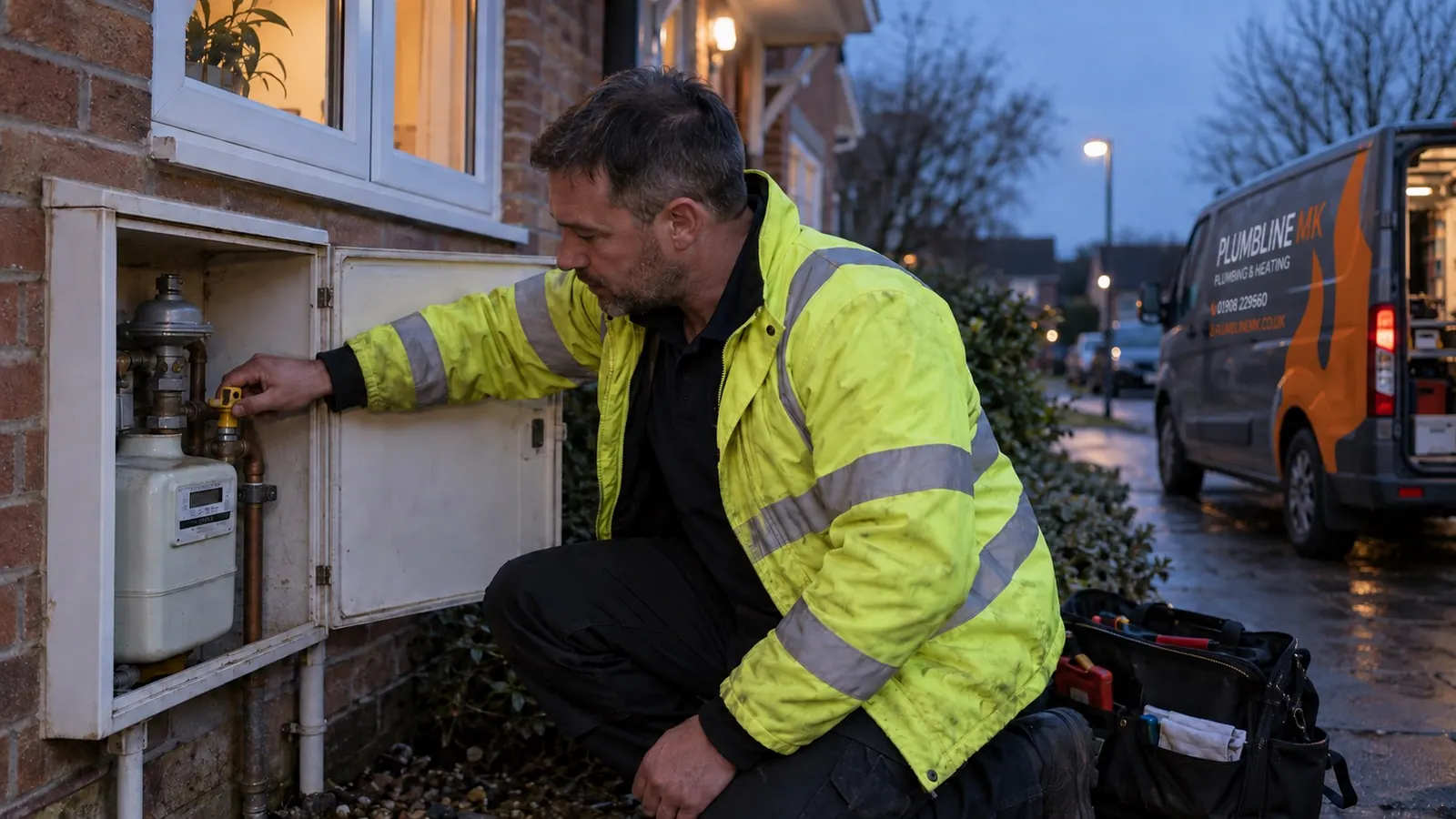
If you can smell gas right now, stop reading and ring 0800 111 999. That is the National Gas Emergency Service. It is free, it answers day and night, and it is the correct first call for anyone in Milton Keynes, Bletchley, Newport Pagnell or any of the surrounding towns. Do not ring us first. We cannot get to you faster than the emergency service can, and we would only tell you to call them.
The rest of this page is for the part nobody explains: what happens once you have made that call. Most people assume the engineer who turns up fixes the problem. Usually they do not, and understanding why saves you a cold night and a wasted phone call.
What the emergency number is for, and what it is not
The 0800 number is a safety service, not a repair service. Cadent, who run the gas network across this area, are direct about this on their own advice pages: call 0800 111 999 if you smell gas or you suspect carbon monoxide. For a meter fault, call your gas supplier, the company you pay your bill to. For a boiler or an appliance that has simply stopped working, call a Gas Safe registered engineer.
When you ring, the operator will give you safety instructions before anyone is dispatched. Follow what they tell you rather than anything you have read, including this page, because they will ask questions about your property that change the answer. Their standard advice is to open doors and windows, avoid electrical switches and naked flames, and turn the gas off at the meter. There is one important exception: if the meter is in a cellar or basement, you are told not to go down there and to leave the building instead.
What the engineer does when they arrive
An engineer from the gas network is sent out. Before knocking, they may take readings around your property and your neighbours' properties, so do not be alarmed if you see them on the pavement first. They will have an ID badge, and Cadent actively encourage you to check it before letting anyone in. Nobody will be offended.
Inside, they investigate, find the source and make the situation safe. What they do next depends entirely on where the problem is:
- If the escape is on the network's pipework, in the street or up to your meter, they raise a repair job and the network fixes it. That can mean digging in the road or on your property, and a second team comes back to reinstate the surface.
- If the escape is on your side of the meter, they make it safe and stop there. Your supply may be capped and stay off until you have arranged your own repair.
- If an appliance is the problem, they will isolate it. Fixing it is not their job.
The line that decides who pays and who calls
This is the bit worth knowing before it happens. The gas network is clear about where responsibility sits:
- The street and the pipes up to your meter: the gas network.
- The meter itself: your gas supplier, the one who bills you.
- Everything from the meter onwards: you, or your landlord. That means the internal pipework as well as the boiler, cooker and fire.
So a leak in the road is somebody else's problem and somebody else's cost. A leak on the run of pipe under your kitchen floor is yours, even though the same free service attended and made it safe. Nothing about the emergency visit changes that, and nothing about it gets your gas back on.
Labels, warning notices and why your gas stays off
If something is found to be unsafe, you will not just be told. You will be shown. A "Danger Do Not Use" label goes on the appliance or fitting, and you are given a written warning notice setting out exactly what the unsafe situation is. Gas Safe Register publishes what the two categories mean: Immediately Dangerous, meaning a danger to life or property if it were left running, and At Risk, meaning faults exist that could become dangerous. In both cases the installation is turned off with your permission and must not be used again until it has been repaired.
Gas Safe Register puts the responsibility plainly: you are advised not to use the appliance until a Gas Safe registered engineer has checked it, and as the homeowner it is down to you to make sure that happens. Refuse permission to disconnect something Immediately Dangerous on natural gas and the emergency service has legal powers to cut the supply anyway.
That warning notice is not a formality. Keep it. Photograph it. It is the document that tells the next engineer what was found, and if you rent, it is what your landlord needs.
Ask for the attendance summary, because almost nobody does
Here is a genuinely useful thing that hardly anyone is told. After an emergency visit, Cadent produce an Engineer Attendance Summary, a PDF you can retrieve yourself with the job reference number and your postcode. It sets out what they attended for and what they did.
Get it before you book anybody. It saves your engineer guessing, it is what a landlord or housing association will ask for, and it is the only neutral record of the visit. Ask for the job reference while the engineer is still in your hallway.
What the repair actually involves
Once the situation is safe, the work splits into finding it, fixing it and proving it. A tightness test on the installation shows whether the pipework is holding. From there it is a matter of tracing the escape, which is straightforward on an exposed run in an airing cupboard and considerably less so under a solid floor in an older Bletchley or Stony Stratford terrace. The faulty section is replaced, the installation is retested, and every appliance is recommissioned and checked before the gas is signed back on.
Access changes the size of that job more than anything else: whether the pipe is buried, boxed in or under a floor, how much of the run has to be replaced rather than patched, and whether the appliance that failed can be repaired or has reached the end. Any honest answer on cost comes after somebody has looked, not over the phone.
One thing that is not negotiable. Only a Gas Safe registered engineer may legally work on gas, and their card carries categories for the specific work they are qualified to do. Ask to see it, and check it. Our guide on how to check a Gas Safe registered engineer takes about a minute to read and less than that to act on.
If it is carbon monoxide rather than a smell
Carbon monoxide has no smell, so there is nothing to notice. If your alarm sounds, or if headaches, dizziness or nausea ease when you leave the house and return when you come back, treat it as an emergency and ring the same number, 0800 111 999. An audible alarm is the only reliable warning there is, which is why we go on about them: see where to put a carbon monoxide alarm and what the law asks of landlords.
The other half of the answer is not letting it get there. An annual check by a Gas Safe registered engineer looks at combustion, ventilation and the flue on every gas appliance, which is precisely the ground carbon monoxide comes from. If you let property, that check is a legal duty rather than a good idea, and our gas safety certificate page covers what it involves.
After the emergency service has been
If the gas has been made safe at your property and you have been told to arrange your own engineer, that is the point to call us. We are Gas Safe registered, we work across Milton Keynes and the towns around it, and we would rather see the warning notice and the attendance summary than work from a description over the phone.
Ring 07805 844 016 or contact us. And if you are reading this because you can smell gas at this moment, close the tab and ring 0800 111 999 first.
Sources
Need Professional Advice?
Our Gas Safe registered engineers are ready to help with all your heating needs. Get a free, no-obligation quote today.