Frozen Outside Tap: Prevent and Thaw It
TL;DR
An outside tap freezes because water sits in the exposed section of pipe. The fix is to isolate it at the internal valve and drain it before the first hard frost - a two-minute job. If it has already frozen, thaw gently with warm cloths, never a naked flame, and check for a split before turning the supply back on.
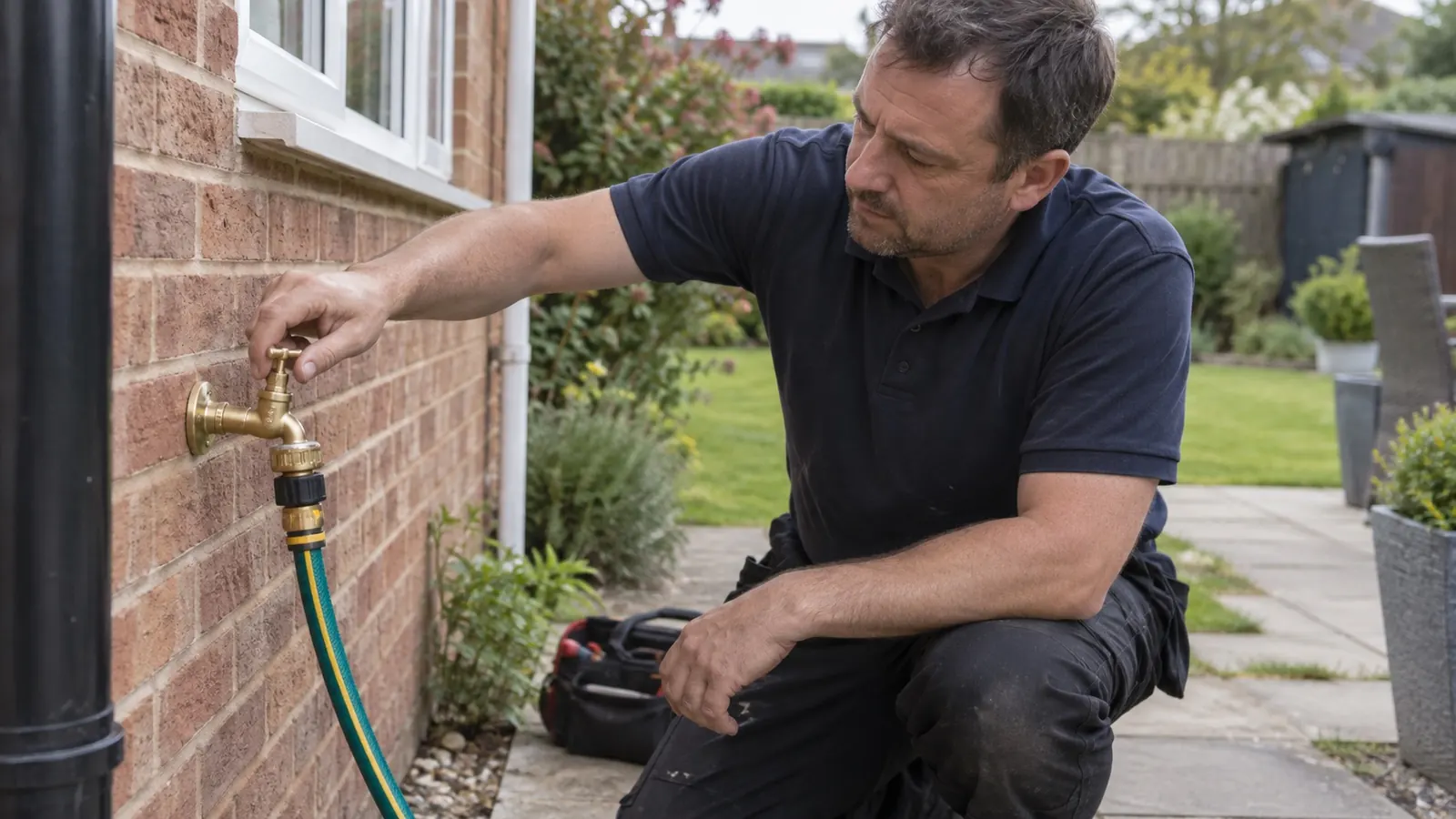
An outside tap looks like the least important plumbing in the house right up to the moment it splits. Then it becomes the most important, because the pipe that feeds it runs through your wall - and a burst on the inside of that wall floods the room behind it.
Why It Freezes
Water expands as it freezes, by roughly nine per cent. In a confined pipe there is nowhere for that expansion to go, so pressure builds until something gives - usually the tap body itself, a compression joint, or the copper pipe just inside the wall.
The exposed section outside is what freezes first. The failure, though, is often found indoors, because the pipe passing through the cold wall cavity is nearly as vulnerable and far less visible.
The cruel part is that you frequently do not discover a split until the thaw. While everything is frozen, the ice itself plugs the leak. When it melts, water starts flowing through the split at mains pressure - which is why burst pipe callouts spike on the first mild day after a cold snap, not during the freeze.
Preventing It - The Two Minute Job
Almost every outside tap installed to modern standards has an isolation valve on the internal pipework, usually just inside the wall, often under the kitchen sink or in a nearby cupboard. Before the first hard frost:
- Find the internal isolation valve. A small lever or a slotted screw valve on the pipe feeding the tap.
- Close it. Lever across the pipe, or screw slot turned across the pipe, means closed.
- Open the outside tap fully and leave it open. This drains the water trapped in the exposed section.
- Leave it open all winter. An open tap with no water in it cannot burst. It also gives any residual water somewhere to expand into.
- Disconnect any hose. A hose left connected holds a column of water against the tap and defeats the whole exercise.
That is the entire preventive measure, and it is dramatically more effective than any amount of lagging.
If There Is No Isolation Valve
Some older installations were plumbed without one. In that case the options are to have one fitted - a small job and well worth doing - or to insulate the exposed pipework and tap thoroughly with a purpose-made tap cover and pipe lagging.
Insulation is a mitigation, not a solution. It slows heat loss; it does not stop a sustained freeze. If your tap has no isolation valve, fitting one is the single most useful winter job on the list.
It is also worth knowing where your main stopcock is before you need it. Our guide on turning off the water at the mains covers finding and testing it.
Thawing a Frozen Tap Safely
If it has already frozen, work gently and patiently:
- Close the internal isolation valve first, if you have one. This limits the damage if there is already a split.
- Open the tap so melting water has somewhere to go and pressure can release.
- Apply gentle heat. Cloths soaked in warm - not boiling - water, wrapped around the tap and exposed pipe and refreshed as they cool. A hairdryer on a low setting, kept moving, also works.
- Work from the tap back toward the wall, so meltwater can escape rather than being trapped behind a remaining plug of ice.
- Be patient. This takes time. Rushing it is how pipes get damaged.
Never use a blowtorch or any naked flame. It risks fire in the wall structure, it can damage the tap's internal seals, and rapid uneven heating can crack the pipe you are trying to save.
After the Thaw - Check Before You Trust It
This is the step people skip. Once water flows, close the tap and reopen the internal isolation valve slowly, then check carefully for leaks - at the tap, at the wall penetration, and on the internal pipework as far back as you can see it.
If you find a damp patch inside, close the isolation valve again and get it looked at. Our guide on finding a water leak covers how to trace one that is not immediately visible.
A split that is only weeping now will get worse. It is not something to leave until spring.
While You Are At It
The outside tap is part of a wider winter preparation that takes very little time. The other high-value items are lagging any accessible pipework in unheated spaces such as lofts and garages, knowing where the stopcock is and checking it actually turns, and leaving the heating on a low background setting rather than off entirely if the property will be empty. The Chartered Institute of Plumbing and Heating Engineering publishes seasonal guidance on protecting domestic pipework, and your water supplier - Anglian Water for this region - also publishes freeze prevention advice for customers.
Frequently Asked Questions
Do I really need to drain it every winter?
Yes, and it takes two minutes. A single hard frost is enough.
Is a tap cover enough on its own?
It helps in a mild frost. It will not reliably protect through a sustained freeze. Draining is what actually works.
My tap drips constantly. Does that matter in winter?
It matters more than usual - a dripping tap keeps water in the pipe and can build an ice collar. Get the washer changed.
Can I leave the tap running slightly to stop it freezing?
It is sometimes suggested, but it wastes water, may not be enough in a hard freeze, and is unnecessary when draining the pipe is available.
What if the pipe has already burst?
Turn off the water at the stopcock immediately, open taps to drain the system down, and call a plumber. Do not wait for the thaw to see what happens.
If It Has Already Gone
Burst pipes are what we deal with most in cold weather, and speed limits the damage. If you have a split or a leak you cannot isolate, turn off at the stopcock and call 07805 844 016, or contact us.
Need Professional Advice?
Our Gas Safe registered engineers are ready to help with all your heating needs. Get a free, no-obligation quote today.