Radiators vs Underfloor Heating in Milton Keynes
TL;DR
In Milton Keynes, wet underfloor heating usually wins for new builds, extensions and open-plan ground floors: even warmth, no wall space lost, and lower running costs because it works at a low flow temperature. Radiators usually win for retrofits in older houses, upstairs bedrooms and anywhere you want quick heat. The most common good answer is both: UFH downstairs, radiators upstairs, electric UFH under bathroom tiles. Installed cost depends on the floor build-up, area and controls.
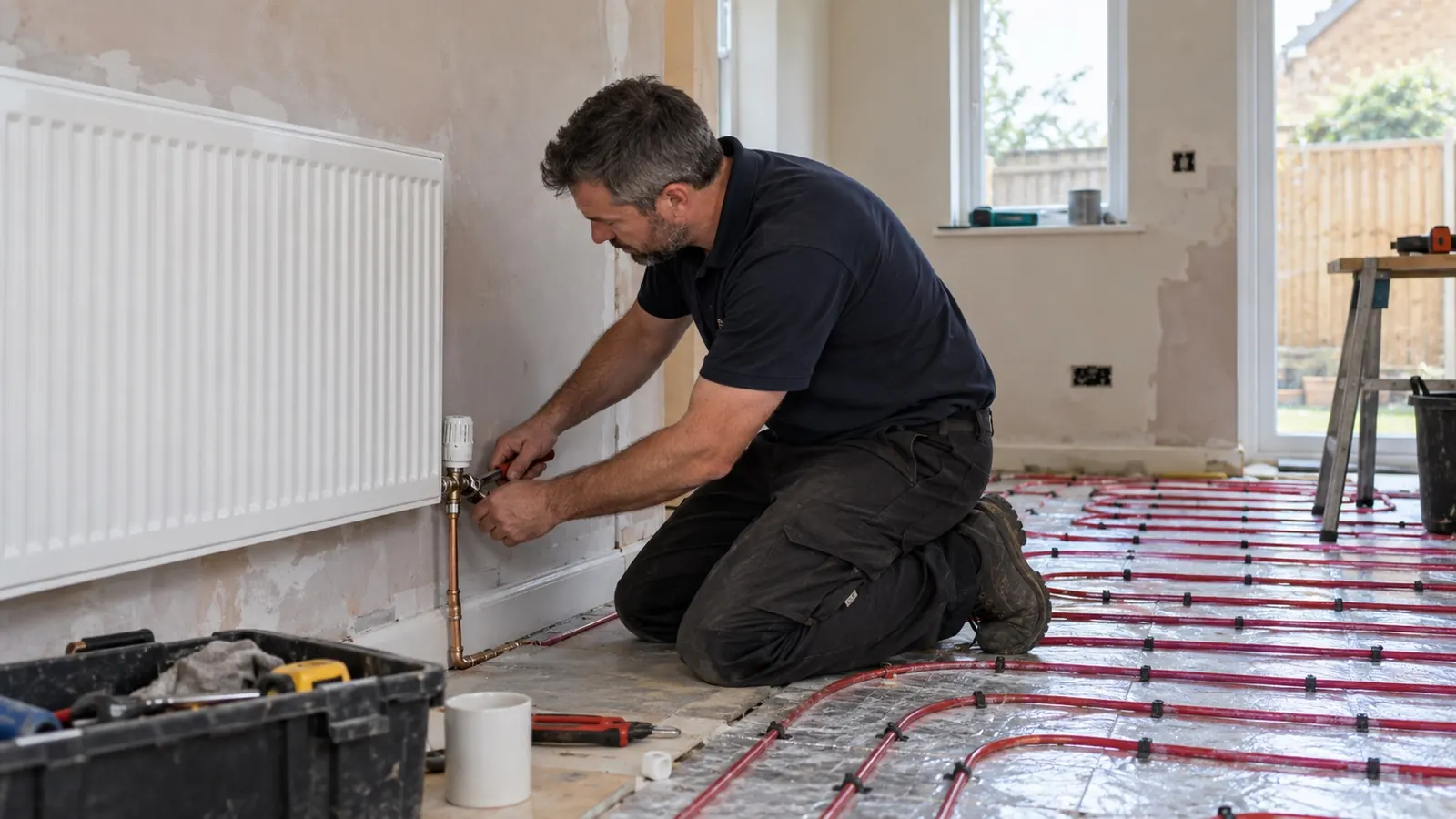
Radiators or underfloor heating comes up nearly every week on Milton Keynes jobs: on the new estates at Broughton, Tattenhoe, Whitehouse and Glebe Farm, and on the steady run of extensions across Newport Pagnell, Woburn Sands and Olney. The short answer is that both are good and they suit different jobs.
We fit both, and it is worth saying plainly that radiators are quicker and simpler for us while underfloor heating is a bigger, more involved job. We have no reason to steer you either way. The right answer is whatever suits your house, your budget and how you live.
Quick answer
- New build, extension or open-plan ground floor: wet UFH nearly always wins.
- Retrofit upstairs, bedrooms or rooms you want warm fast: radiators nearly always win.
- Bathroom, any property: electric UFH under the tiles plus a towel rail is the standard upgrade.
- Whole-house retrofit in an older property: radiators, unless you are already lifting the floors.
How each one heats a room
A radiator is a small, hot surface. It heats the air near it, which rises and circulates, so you get warm spots by the radiator and cooler corners, and it feels warmest at head height. Wet UFH turns the whole floor into a large, gently warm surface, so the heat is even across the room and warmest at your feet, which is where people notice it. Because the surface is so large, the water in the pipes only needs to be warm rather than hot.
Running cost
That flow temperature is the whole story on running cost. Radiators normally run on water in the region of 60 to 75C. UFH runs at around 35 to 45C. A condensing boiler recovers more heat from its flue gases the cooler the water coming back to it, so a UFH system spends far more of its time in condensing mode and burns less gas for the same warmth. Radiators can get part of the way there if they are generously sized and the boiler flow temperature is turned down, which is worth doing whichever you choose.
The gap gets bigger if a heat pump is in your future. Heat pumps are at their most efficient at exactly the low temperatures UFH needs, and the Energy Saving Trust covers why low-temperature heating matters for them. UFH plus a heat pump is the most efficient combination you can put in a house. Our gas boiler vs heat pump comparison goes further into that.
Electric UFH is a different animal. It is cheap and easy to lay under bathroom tiles but expensive to run over any large area, because electricity costs a lot more per unit of heat than gas. Keep it to bathrooms and small floors.
The comparison in one place
- Installed cost: radiators lower, UFH higher, unless the floor is already up.
- Running cost: UFH lower.
- Even warmth and warm feet: UFH.
- Heat-up speed from cold: radiators, in minutes rather than hours.
- Wall space: UFH frees all of it.
- Retrofit difficulty: radiators easy, UFH hard.
- Lifespan: a radiator lasts decades; buried UFH pipe should outlast the house.
- Maintenance: radiators need a bleed and the odd valve; UFH needs almost nothing if it was filled with inhibitor and pressurised properly.
- Works with a combi: both, UFH via a manifold with a blending valve.
- Works with a heat pump: UFH ideal; radiators only if sized up.
- Floor coverings: radiators do not care; UFH prefers tile, stone, engineered wood or LVT and dislikes thick carpet.
- Control: radiators per room with TRVs; UFH per zone at the manifold.
Which suits your MK property?
New build (Tattenhoe, Whitehouse, Broughton, Glebe Farm). Most MK new builds of the last few years already have wet UFH on the ground floor and radiators upstairs, and that is the right configuration. If you are specifying a self-build, copy it.
Extension, any area. Nearly always UFH. You are already pouring a screed or building up a new floor, so laying pipe before the screed is a small addition to a job that is happening anyway, and you get the lower running cost and clear walls in what is usually a kitchen-diner. See our underfloor heating service.
Older terrace (Wolverton, Stony Stratford, Bletchley). Retrofit UFH is genuinely hard in houses with suspended timber floors or low ceilings. Low-profile overlay systems exist but add around 18 to 22 mm to the floor height, which upsets door clearances, skirtings and stair transitions. For most older terraces, radiators, perhaps upgraded to slimmer or vertical models, are more practical and much cheaper. We will tell you if UFH is not worth it in your house.
1970s to 1990s grid-square semi (most of MK). Radiators upstairs, and UFH downstairs only if the ground floor is coming up anyway for an extension or a full kitchen refit. Bolting UFH onto an intact solid floor purely for its own sake rarely justifies the disruption.
Bungalow (Newport Pagnell, Olney, Bedford). Often a strong candidate, especially during a full re-floor. Single-storey heat loss suits UFH and the cost spreads over the whole heated footprint.
What changes the price of each
We do not put figures here, because a number that is right for one floor is wrong for the next one. What moves the quote:
- Radiators: like-for-like swap or new position with new pipework; standard panel, vertical or designer; towel rails; whether TRVs or smart valves are going on at the same time; and whether the system needs a clean first.
- Wet UFH: the floor build-up (pipe in a new screed is the cheapest metre; a low-profile overlay on an existing floor is the dearest); the area; the number of zones and the manifold; the controls; and whether the boiler needs any changes to run a second, low-temperature circuit.
- Electric UFH: the area and the floor finish going on top.
A proper quote is a site visit, a floor area, a heat loss check and a conversation about how you use the rooms. Anyone quoting a wet UFH price per square metre over the phone is guessing.
Will my combi run UFH?
Most modern combis will, provided there is a properly sized manifold with a blending valve to drop the water from boiler temperature down to floor temperature. The manifold also protects the boiler from short-cycling. Running radiators upstairs and UFH downstairs off one combi gives you a two-temperature system, which is the most common set-up in MK new builds and works well. Our underfloor heating in MK guide has more detail.
Response time: the most misunderstood trade-off
UFH takes a couple of hours or more to come up from cold; radiators take minutes. That sounds like a big mark against UFH, and it is if you try to run it like radiators, off all day and blasted for an hour at each end. UFH is meant to run steady, held at a low constant temperature and drifting a degree or two either way. With a thermostat that learns your schedule and pre-heats, well-controlled UFH feels every bit as responsive, because the room never really gets cold in the first place. The people who are unhappy with UFH are almost always the people who were never shown how to control it.
Floor coverings over UFH
- Tile or stone: excellent.
- Engineered wood: good; most products are UFH-rated.
- LVT or vinyl: good.
- Solid wood: usable but it moves with humidity; choose carefully.
- Laminate: usable; check the TOG rating.
- Carpet: only thin carpet on a low-TOG underlay, with the combined rating kept low. Thick carpet on thick underlay defeats the system.
MK's hard water and UFH
The heating water in a sealed UFH system is the same water going round and round, so scale is not the problem it is on the hot water side of a combi. What matters is that the system was filled with inhibitor, has a magnetic filter, and is kept at the right pressure. A UFH circuit that has been run for years with no inhibitor can silt up the manifold and actuators, and clearing that is a job. It is worth a check on the boiler's annual service.
Frequently asked questions
Which is cheaper to run?
Underfloor heating, because it runs at a low flow temperature and keeps a condensing boiler in its efficient range for longer. The saving is real but it is not enough on its own to justify ripping up a sound floor.
Can I have both?
Yes, and it is the standard MK configuration: wet UFH downstairs, radiators upstairs, electric UFH under bathroom tiles.
Is UFH worth it in an older house?
Only if the floors are coming up anyway. Otherwise upgrade the radiators and turn the boiler flow temperature down.
Does UFH need servicing?
Very little. Keep the pressure right, have the inhibitor checked at the boiler service, and expect the manifold actuators to need replacing eventually.
Not sure which suits your house?
Get in touch and describe the house and the job. Robert or Sam will come and look, tell you honestly which option makes sense, and quote it properly. If the answer is radiators, we will say so.
Need Professional Advice?
Our Gas Safe registered engineers are ready to help with all your heating needs. Get a free, no-obligation quote today.