New-Build Boilers in Milton Keynes: What Owners Should Know
TL;DR
New-builds on Milton Keynes developments usually come with a developer-grade boiler such as an Ideal Logic, Baxi 600 or 800, or Worcester Bosch Greenstar 4000. The builder is responsible for defects in the first two years. After that the boiler relies on its manufacturer warranty, which only holds if it was registered and is serviced every year. Find the paperwork, check the registration yourself and book the first service before the anniversary of your move-in.
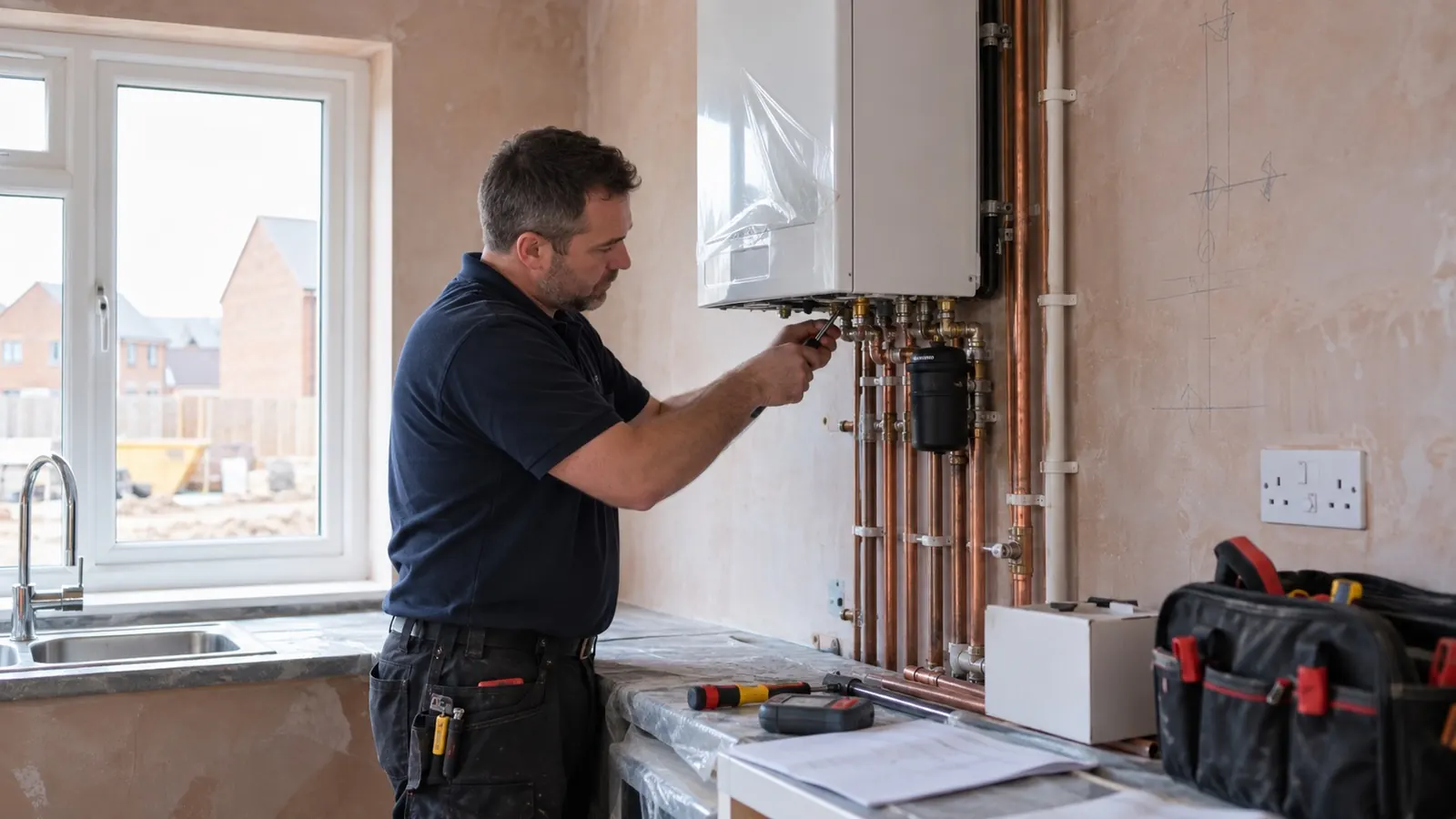
Milton Keynes has been building houses faster than almost anywhere in the south of England for twenty years. Broughton Gate, Tattenhoe Park, Whitehouse, Newton Leys, the Western Expansion Area and the new estates around Magna Park have all filled up with homes whose owners assumed the boiler was the one thing they would not have to think about. Mostly that is true. The exceptions are predictable, and this is what we wish every new-build buyer knew on day one.
One thing first: any work on the boiler, including the annual service, must be done by a Gas Safe registered engineer. The service is what keeps the warranty alive, so this matters more than it sounds.
What developers actually fit
Housebuilders buy boilers in bulk, and they choose on unit cost, installation speed and warranty terms rather than on what a homeowner would pick for themselves. Around Milton Keynes that usually means one of:
- Ideal Logic or Logic+. The most common by far. British-built, cheap parts, sound boiler.
- Baxi 600 or 800. A reliable mid-range combi with good parts availability.
- Worcester Bosch Greenstar 4000. Fitted on some of the higher-spec plots. Strong name for resale.
- Vaillant ecoTEC pro. Less common at developer scale but it turns up.
These are not the same models a homeowner would be offered for a replacement (a Greenstar 8000 Life, an ecoTEC plus, a Vogue Max). They are the entry to mid-range versions, with shorter warranties. That is not a problem in itself. It just means you should know what is on your wall and what its warranty actually says.
NHBC cover: what it does and does not do
Most new homes here come with NHBC Buildmark or a similar structural warranty. The way it works catches people out:
- Years one and two: the builder is responsible for putting right defects, and that includes the boiler and heating system. Report faults to the developer's customer care team in writing.
- Years three to ten: the warranty covers structural problems with the building. The boiler is not a structural element. From year three, it is the manufacturer's warranty you are relying on, and nothing else.
So the ten-year umbrella that the sales office talked about is really a two-year umbrella for the boiler, followed by whatever the boiler manufacturer promised, on the manufacturer's conditions.
What to check in the first 90 days
Four jobs, none of them technical, all of them worth an hour of your time.
1. Find the paperwork
Your handover pack should contain the manufacturer's warranty registration confirmation, the Benchmark commissioning checklist (a booklet or card filled in by the installer with pressures, flow temperatures and combustion readings), the Building Regulations compliance certificate for the gas installation, and the installer's Gas Safe details. If anything is missing, ask the developer for it in writing now, while they still have a customer care team on site. Do not accept 'it will follow'.
2. Check the warranty registration yourself
Take the serial number from the data plate on the boiler and check registration directly with the manufacturer, online or by phone. Do this even if you have a certificate. Batch registrations on big sites do go wrong, and the failure is silent until you make a claim. If it was not registered, contact the manufacturer with the Benchmark checklist and your completion date and ask for it to be registered late. Some will, some will not, and the sooner you ask the better your chances.
3. Read the Benchmark checklist
It should show a system flush, an inhibitor dose, a filter fitted, a cold-fill pressure, and combustion readings. Blank boxes tell you what was rushed.
4. Book the year-one service before the anniversary
Put it in the diary at eleven months. The first service is a warranty condition for every brand above, and the warranty does not care that the boiler is new. Missing it is the most common reason a year-four claim gets refused.
What developer installs commonly get wrong
This is not a dig at any particular builder. Plumbing schedules on a big site are tight and commissioning is where time gets saved. On year-one services across Milton Keynes developments, these are the things we find most often:
- No system flush and no inhibitor. The system was filled with mains water and left. Sludge starts forming in year one. Fixable with a clean and a dose of inhibitor.
- No magnetic filter. Some specs leave it out. It is a straightforward retrofit and it protects the most expensive part of the boiler.
- Pressure never settled. Commissioned at 1.5 bar cold, but the air was never fully bled, so it sags after the first heating season and the boiler throws a low-pressure code.
- Every radiator valve left on maximum. Rooms overheat, the boiler cycles, the bills are higher than they should be. Ten minutes of setting the TRVs room by room and balancing the radiators fixes it.
- Smart thermostat fitted but never paired properly. Running on a default schedule with the boiler ignoring it.
- Condensate pipe run outside with thin lagging. Freezes in the first proper cold snap and the boiler locks out. Proper weatherproof insulation, or rerouting, sorts it for good.
- Flow temperature left at factory maximum. A condensing boiler only condenses, and only earns its efficiency rating, at lower flow temperatures. Turning it down costs nothing.
None of these are dangerous. All of them shorten the boiler's life or push your bills up, and all of them are caught by a proper first service.
What a year-one visit involves
A boiler service on a new-build is the standard service plus a check of the things above: the commissioning record, the inhibitor level, the filter, the pressure, the controls, the condensate route and the flow temperature. Where something needs putting right, we will tell you whether it is a defect the developer should fix under the two-year warranty, or a small job worth doing there and then. Those two things are not in conflict. We regularly write a short note for a homeowner to send to the developer's customer care team, and then handle the service separately.
What you pay depends on what is found. The service itself is a fixed job. Adding inhibitor is a small extra. Fitting a magnetic filter or re-lagging a condensate run is a separately quoted item because it depends on the pipework and the access. Nothing gets added without you agreeing it first.
Developer or independent engineer?
- Call the developer in years one and two for anything that is clearly a defect: leaks, a boiler that will not fire, codes that will not clear, a part that fails early. That is what the builder's warranty is for. Report it in writing and keep the thread.
- Call an independent Gas Safe registered engineer for the annual service in any year, for setting the system up properly, and for a second opinion when the developer says a fault is 'normal'.
Here is the honest point: the developer's customer care team will often send their own contractor to fix a defect, and that contractor may be the same firm that rushed the commissioning. That is your right under the warranty and you should use it. Just get the fix written down, and have someone independent check the boiler at the first service.
Milton Keynes new-build specifics
Two local things worth knowing. First, the water here is very hard, and a new-build combi with no scale protection will start losing hot water performance within a few years. A scale reducer on the incoming main is cheap insurance and the developer will not have fitted one. Second, a lot of new estates have the boiler in a utility cupboard or a first-floor cupboard with a long external condensate run, which is exactly the setup that freezes. Check where yours goes before December.
Moving into a new-build in Milton Keynes?
We service developer-fitted boilers across Tattenhoe, Broughton, Whitehouse, Newton Leys, Westcroft and the rest of the city, and we know what the common specs look like and what tends to need correcting. Plumbline MK is Gas Safe registered (957816). Get in touch to book a year-one service, or just to ask us to look over your paperwork.
Need Professional Advice?
Our Gas Safe registered engineers are ready to help with all your heating needs. Get a free, no-obligation quote today.