Landlord Gas Safety Certificates in Milton Keynes: Legal Requirements, Costs & Staying Compliant in 2026
TL;DR
If you let property in Milton Keynes with gas appliances, the law requires an annual gas safety check carried out by a Gas Safe registered engineer. This guide explains the CP12 certificate, what is checked, costs, renewal deadlines, the penalties for getting it wrong, and the extra rules that apply to HMOs.
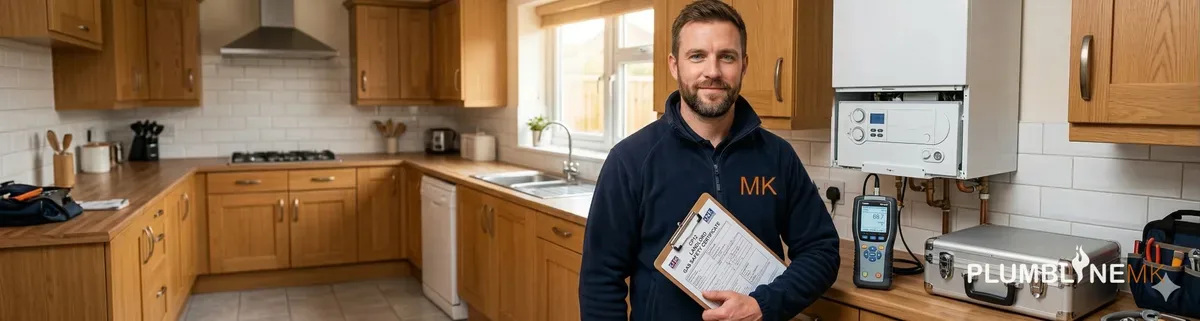
Letting a property in Milton Keynes carries a legal duty that catches out far more landlords than it should: the annual gas safety check. Whether you own a single buy-to-let in Bletchley, a portfolio across Wolverton and Stony Stratford, or you manage tenancies on behalf of clients as a letting agent, the responsibility for gas safety sits squarely with you. Getting it wrong is not a paperwork slip-up. It is a criminal matter, with unlimited fines and the prospect of imprisonment in the most serious cases.
This guide takes a deliberately compliance-focused view. We explain exactly what a landlord gas safety certificate is, the law that requires it, what a Gas Safe registered engineer checks, what it costs in Milton Keynes in 2026, how often it must be renewed, the penalties for non-compliance, and the additional obligations that apply to Houses in Multiple Occupation (HMOs). If you simply want the basics, our gas safety certificate service page covers the essentials, but read on for the detail that keeps you on the right side of the law.
What is a Gas Safety Certificate (CP12)?
A Gas Safety Certificate is the document a Gas Safe registered engineer issues after inspecting the gas appliances, fittings and flues in a let property. It is formally called the Landlord Gas Safety Record, and you will still hear it referred to by its old industry code, CP12. The terms are used interchangeably, and they all describe the same thing: documented proof that the gas installations in your property have been checked and found safe within the last 12 months.
The certificate records every gas appliance inspected, the safety checks carried out, any defects identified, and whether each appliance passed or failed. It also names the engineer and shows their Gas Safe registration number, which is what makes the document legally valid. A certificate issued by anyone who is not on the Gas Safe Register is worthless. If you are ever unsure whether an engineer is properly registered, our guide to checking the Gas Safe Register walks you through how to verify their credentials in minutes.
The Legal Obligation: Gas Safety (Installation and Use) Regulations 1998
The duty comes from the Gas Safety (Installation and Use) Regulations 1998, the cornerstone of gas safety law in the UK. Regulation 36 places three core duties on anyone who lets residential property:
- Maintenance: You must keep all gas pipework, appliances and flues in a safe condition. This is an ongoing duty, not a once-a-year tick-box.
- Annual safety checks: Every gas appliance and flue must be checked for safety at least once every 12 months by a Gas Safe registered engineer.
- Record keeping: You must obtain a record of each safety check, keep it, and provide copies to your tenants.
These duties apply to most residential lettings, including assured shorthold tenancies, room lets, and short-term lets such as holiday accommodation. Importantly, the regulations cover appliances the landlord owns and provides. A tenant's own gas cooker, for example, is generally outside the scope, but the pipework feeding it and any landlord-owned flue serving it remain your responsibility. If in doubt, treat the whole installation as yours to check.
What a Gas Safe Engineer Checks During a Landlord Inspection
A proper landlord gas safety inspection is more than a quick glance. During the visit, a Gas Safe registered engineer will:
- Check that each appliance is burning gas correctly and operating at the right pressure.
- Test for the safe and complete combustion of gas, including a flue flow and spillage test where relevant.
- Confirm that flues and chimneys are clearing products of combustion safely to the outside.
- Inspect ventilation to ensure appliances have enough air to burn safely.
- Verify that all safety devices, such as flame supervision and cut-outs, function correctly.
- Examine visible pipework and connections for soundness and signs of corrosion or leaks.
The engineer is checking for safety, not condition or efficiency. An appliance can pass a gas safety check yet still be old and inefficient. That distinction matters: a safety check is not a service. A service is a more thorough clean and inspection designed to keep a boiler running reliably and efficiently. Many landlords sensibly combine the two on the same visit, and our boiler servicing can be carried out alongside the certificate. To understand what a full service involves, see our step-by-step service guide.
How Much Does a Gas Safety Certificate Cost in Milton Keynes?
Costs vary with the number of appliances and the property type. As a guide for Milton Keynes in 2026, expect the following:
| Scenario | Typical 2026 cost |
|---|---|
| Single appliance (e.g. one boiler) | £60 to £90 |
| Two appliances (boiler plus gas hob or fire) | £80 to £120 |
| Three or more appliances | £100 to £150+ |
| Certificate combined with a full boiler service | £120 to £180 |
Be wary of prices that look too good to be true. A genuine inspection takes time and must be carried out by a registered engineer. Bundling the safety check with an annual service often represents the best value, because the engineer is already on site and the combined fee is lower than booking the two separately. For an exact quote on your property, the team at Plumb Line MK will confirm the price upfront with no surprises.
How Often Must It Be Renewed?
A landlord gas safety check must be carried out at least every 12 months. The certificate itself does not have a fixed expiry date in the way an MOT does, but the underlying duty is to have a valid check no older than 12 months at all times.
There is a helpful rule that protects diligent landlords. You can have the next check carried out up to two months before the current one expires, and the new certificate's deadline still runs from the original expiry date rather than the date of the new check. This means you do not lose time by booking early, so there is never a good reason to leave it to the last minute. Set a reminder, book in advance, and you avoid any risk of a gap.
For new tenancies, the rule is firm: a valid gas safety record must be in place before a new tenant moves in. You cannot let a tenant take occupation and then arrange the check afterwards.
Penalties for Non-Compliance
The consequences of failing to meet your gas safety duties are severe, and the courts take them seriously. Under the Health and Safety at Work etc. Act 1974 and the 1998 Regulations, landlords who break the law face:
- Unlimited fines. There is no cap. Penalties run into thousands of pounds even for relatively minor breaches, and far more where there is a pattern of neglect.
- Imprisonment of up to six months on summary conviction, and potentially longer for more serious cases tried in the Crown Court.
- Corporate or gross negligence manslaughter charges in the worst cases, where a failure to maintain gas safety leads to a death from carbon monoxide poisoning or an explosion.
- Invalid insurance. Many landlord insurance policies are void if you have not complied with statutory gas safety obligations, leaving you exposed to the full cost of any incident.
Beyond the legal risk, non-compliance can complicate possession proceedings. Failing to provide a gas safety record to a tenant at the right time has historically caused problems for landlords seeking to regain their property. The simplest protection is straightforward: keep your checks current and your paperwork in order.
Providing the Certificate to Tenants and Keeping Records
Issuing the certificate is only half the job. The law also dictates how and when you must hand it over:
- To existing tenants: a copy of the record must be given within 28 days of the check being completed.
- To new tenants: a copy must be provided before they move in. If the property has gas, no new tenant should ever take occupation without first receiving a valid record.
- Retention: you must keep a copy of each gas safety record for at least two years.
A digital copy by email is acceptable provided the tenant has agreed to receive documents electronically. Keep clear evidence of when and how you provided each certificate, as this proof can be decisive if a dispute or possession claim ever arises. Letting agents managing tenancies on a landlord's behalf should build these deadlines into their compliance calendar so nothing slips.
What to Do If an Appliance Fails the Inspection
If the engineer identifies a fault, the appliance may be classified according to its severity. The most serious categories are Immediately Dangerous and At Risk. With the tenant's permission, the engineer will normally make a dangerous appliance safe, which may mean disconnecting or capping it off, and will issue a warning notice.
As the landlord, your duty is to arrange repairs promptly using a Gas Safe registered engineer. You cannot ignore a failed appliance, and you must not allow a tenant to keep using one that has been deemed unsafe. Once the repair is complete and the appliance passes, an updated record is issued. Acting quickly is both a legal obligation and a moral one: a faulty gas appliance can produce carbon monoxide, which is odourless and potentially fatal. We strongly recommend ensuring every let property also has a working carbon monoxide alarm in each room containing a fuel-burning appliance, which is a separate legal requirement in England.
HMOs: Additional Requirements for Houses in Multiple Occupation
Houses in Multiple Occupation carry heightened obligations because more people, often unrelated, share the property and the risks are correspondingly greater. A property is generally an HMO where it is occupied by three or more tenants forming more than one household who share facilities such as a kitchen or bathroom. Larger HMOs, typically those with five or more occupants, usually require a mandatory licence from Milton Keynes City Council.
For HMOs, the annual gas safety check under the 1998 Regulations still applies in full, but additional duties layer on top:
- Licensing conditions: a current gas safety certificate is a standard condition of an HMO licence. The council can require you to produce it, and operating a licensable HMO without one puts the licence and your right to let at risk.
- Annual submission to the council: licensed HMOs are commonly required to provide a copy of the latest gas safety certificate to the local authority each year, not just to tenants.
- More appliances, more checks: HMOs often contain multiple kitchens, several gas appliances and shared heating systems, so inspections take longer and the certificate covers more equipment.
- Stricter enforcement: HMO standards are actively enforced, and the Management of Houses in Multiple Occupation Regulations reinforce the duty to maintain gas installations in safe working order at all times.
If you let an HMO in Milton Keynes, treat gas safety as a continuous compliance commitment rather than an annual event. Keep certificates current, submit them to the council as required by your licence, and document every check. The penalties for HMO breaches can include the unlimited fines and imprisonment described above, alongside civil penalties and the loss of your licence.
Get Your Landlord Gas Safety Certificate in Milton Keynes
Compliance does not need to be complicated. Plumb Line MK is a Gas Safe registered firm carrying out landlord gas safety checks across Milton Keynes and the surrounding area, with upfront pricing, prompt booking and clear documentation. Whether you have one property or a managed portfolio of HMOs, we will keep your certificates current and your records audit-ready.
Call us today on 07805 844 016 or 01908 229 560, or get in touch through our contact page to book your landlord gas safety inspection and protect your tenants, your property and your legal position.
Need Professional Advice?
Our Gas Safe registered engineers are ready to help with all your heating needs. Get a free, no-obligation quote today.