Boiler Replacement in Stony Stratford: Listed Buildings and the Conservation Area
TL;DR
A boiler can be replaced in a listed or conservation area house in Stony Stratford, but three sets of rules meet at the flue. The Building Regulations fix where a terminal may go. In a conservation area a new flue on a street-facing front or side wall is not permitted development. In a listed building, work that affects its character, inside or out, needs listed building consent first. A like-for-like swap in the existing position is normally the least disruptive job.
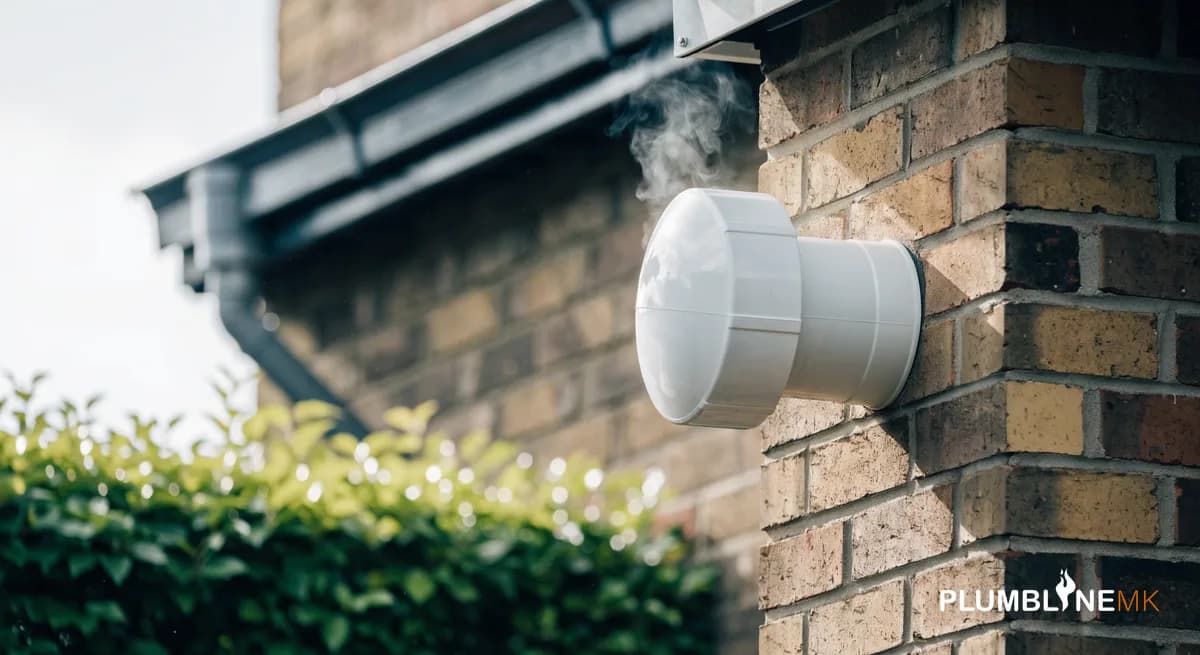
The High Street, Market Square, Church Street and Horsefair Green are a conservation area, the parish has nine Grade II* and 134 Grade II listed buildings, and the council's own conservation area review notes that the Georgian stone and brick fronts along the High Street often hide timber-framed buildings behind them. None of that stops a boiler being replaced. It does change what the survey has to look at, what can be decided on the day and what has to go to the council first. This page covers the three sets of rules that meet at the flue, what our survey checks in an older building, and what moves the price.
Three sets of rules meet at the flue
Almost everything that makes a heritage installation different comes down to where the flue terminal ends up, and three different rules apply to that one decision.
- The Building Regulations. Approved Document J sets out the distances a flue terminal must keep from windows, doors, air vents, boundaries, eaves and the ground, and the boiler manufacturer's installation instructions set the clearances for that particular appliance. A new boiler has to meet them even where the old one did not. Our flue regulations guide covers the typical figures.
- Planning. Fitting or replacing a flue on a house is normally permitted development under Class G of the General Permitted Development Order. In a conservation area it is not permitted development if the flue would go on a wall or roof slope that fronts a highway and forms the front or a side elevation of the house, and no flue may rise a metre or more above the highest part of the roof. On a High Street or Market Square house that rules out the street-facing wall without an application. Those rights apply to houses, not flats, so a new external flue on a flat above a shop is a planning question from the start.
- Listed building consent. Under section 7 of the Planning (Listed Buildings and Conservation Areas) Act 1990, no work may alter a listed building in a way that affects its character as a building of special architectural or historic interest without consent. The government's planning guidance says the listing covers the whole building, inside and out, that work without consent is a criminal offence under section 9 of the Act, that there is no fee for applying, and that if there is any doubt the owner should talk to the local planning authority before starting.
A flue position that satisfies Approved Document J can still need consent, and consent does not relax the clearances.
What that means in a Stony Stratford building
We are heating engineers, not planning consultants: we can tell you which parts of the job are likely to need consent, and the council decides whether they do. In the old town the questions are usually these.
- A straight swap in the same place. If the existing boiler is in a sensible position, its flue already meets the current clearances and the new boiler can use the same opening, the work touches very little historic fabric. That is the version most likely to go ahead without an application, but on a listed building it is still the council's call, and we will say so.
- A new hole in an old wall. Moving the boiler, or routing a flue through a wall that has not been drilled before, means cutting through stone, handmade brick in lime mortar or, behind some High Street fronts, a timber frame. On a listed building that is the kind of alteration that usually needs consent, and the application time has to be built into the plan.
- The chimney. The council's review says plainly that chimney stacks and pots are an important part of the town's character and that losing chimneys on even unlisted buildings in the conservation area should be resisted. A redundant chimney stays. If the old boiler used the chimney as its flue, the new one will almost certainly need a different route, and the chimney is made safe rather than removed.
- The rear plot. The medieval burgage plots behind the High Street are long and narrow, and the rear elevation is where most flues in the old town end up. That suits the planning rules, but a rear courtyard brings its own clearance problems: neighbouring windows, a boundary a few feet away and a plume that has to go somewhere.
- Flats above the shops. Long pipe runs, a cupboard never meant for a condensing boiler and a landlord who needs a gas safety certificate every year. The condensate drain, which cannot run down a front elevation, and the flue route are the usual sticking points.
What the survey checks in an older building
A survey in the old town takes longer than one on Galley Hill, which is why we do not quote over the phone.
- The wall itself. Thickness, material and what is behind the render. Solid stone or brick in lime mortar is drilled and made good differently to a cavity wall, and a timber frame changes the flue design altogether.
- The gas run. The manufacturer's instructions set the pipe size and pressure the new boiler needs, and a supply sized for whatever was fitted decades ago may not deliver it.
- Heat loss and radiators. Solid walls lose heat differently to insulated cavity walls, so radiators are sized for the room, not copied from what is there, and the boiler is sized for the house.
- The system water. Stony Stratford is a hard water area on Anglian Water's own figures, and old systems have usually been altered many times. What comes out when it is drained decides whether it needs a chemical clean or a powerflush first.
- Timing. If any part of the job looks likely to need consent, the application goes in before the old boiler fails, not after.
What changes the price
We do not publish installation prices, and in the old town two neighbouring buildings can come out very differently. A written quote is built from:
- Whether the boiler stays put. A like-for-like swap on the existing flue opening is the simplest job. A new position with a new flue route through historic fabric is the most involved.
- The flue route: a short horizontal run through a rear wall, or a longer or vertical route to reach a position that satisfies both the clearances and the planning rules.
- The making good. Lime mortar and matching brick or stone take longer than a bead of mastic.
- Gas pipe upgrades, if the survey finds the run undersized.
- System cleaning and water treatment, decided on what the system holds, with a filter and scale protection to meet the boiler warranty terms.
- The consent process. The application carries no fee, but drawings, the wait and any conditions the council attaches affect when the job can happen and how.
- Anything the wall hides. A timber frame or a void behind panelling is discussed and priced when it is found, not added to the bill afterwards.
The honest bit
Two things a firm that sells boilers for a living tends not to say. First, if your boiler is in a sensible place and its flue is compliant, do not let anyone talk you into moving it. The least disruptive job in a listed building is nearly always the right one. Second, if an installer tells you nobody checks and the consent is a formality you can skip, walk away. The offence in the 1990 Act covers causing the work to be done, so it is the owner's problem as much as the installer's.
Galley Hill and Fullers Slade are a different job
The 1970s estates between the town and the A5 are outside the conservation area and have no listed buildings, so none of the consent questions above apply there. Our Stony Stratford boiler installation page covers them.
Booking a survey in Stony Stratford
We are based at Grange Farm on the west side of Milton Keynes, about four miles and ten minutes from the High Street up the V4 Watling Street, and Stony Stratford is one of the closest towns we cover. The survey is free, the quote is written and itemised, and if any part of the job looks like a consent question we say so before you commit to anything.
Georgian house on the High Street or flat above a shop on Market Square: tell us what you have and we will tell you plainly what it needs. Read about our boiler installation service, or get in touch to book a visit.
Sources
- Milton Keynes Council, Stony Stratford Conservation Area Review (Georgian fronts masking timber frames; chimney stacks and pots; loss of chimneys to be resisted)
- Stony Stratford, Wikipedia (nine Grade II* and 134 Grade II listed buildings, from Historic England's list)
- General Permitted Development Order 2015, Schedule 2, Part 1, Class G (flues on a dwellinghouse; the conservation area and height conditions)
- Planning (Listed Buildings and Conservation Areas) Act 1990, section 7 and Planning Practice Guidance, Historic environment (listing covers the whole building; section 9 offence; no fee; ask the council if in doubt)
- Building Regulations, Approved Document J and Approved Document L
- Anglian Water, Hard water
Need Professional Advice?
Our Gas Safe registered engineers are ready to help with all your heating needs. Get a free, no-obligation quote today.