Landlord vs Tenant Boiler Responsibility in Milton Keynes
TL;DR
In a Milton Keynes rental the landlord is legally responsible for repairing and replacing the boiler and for the annual gas safety check. Section 11 of the Landlord and Tenant Act 1985 puts heating and hot water on the landlord, and a tenancy clause cannot shift it. The tenant must report faults promptly, allow access, and look after the system day to day. Only damage the tenant clearly caused can be charged back to them.
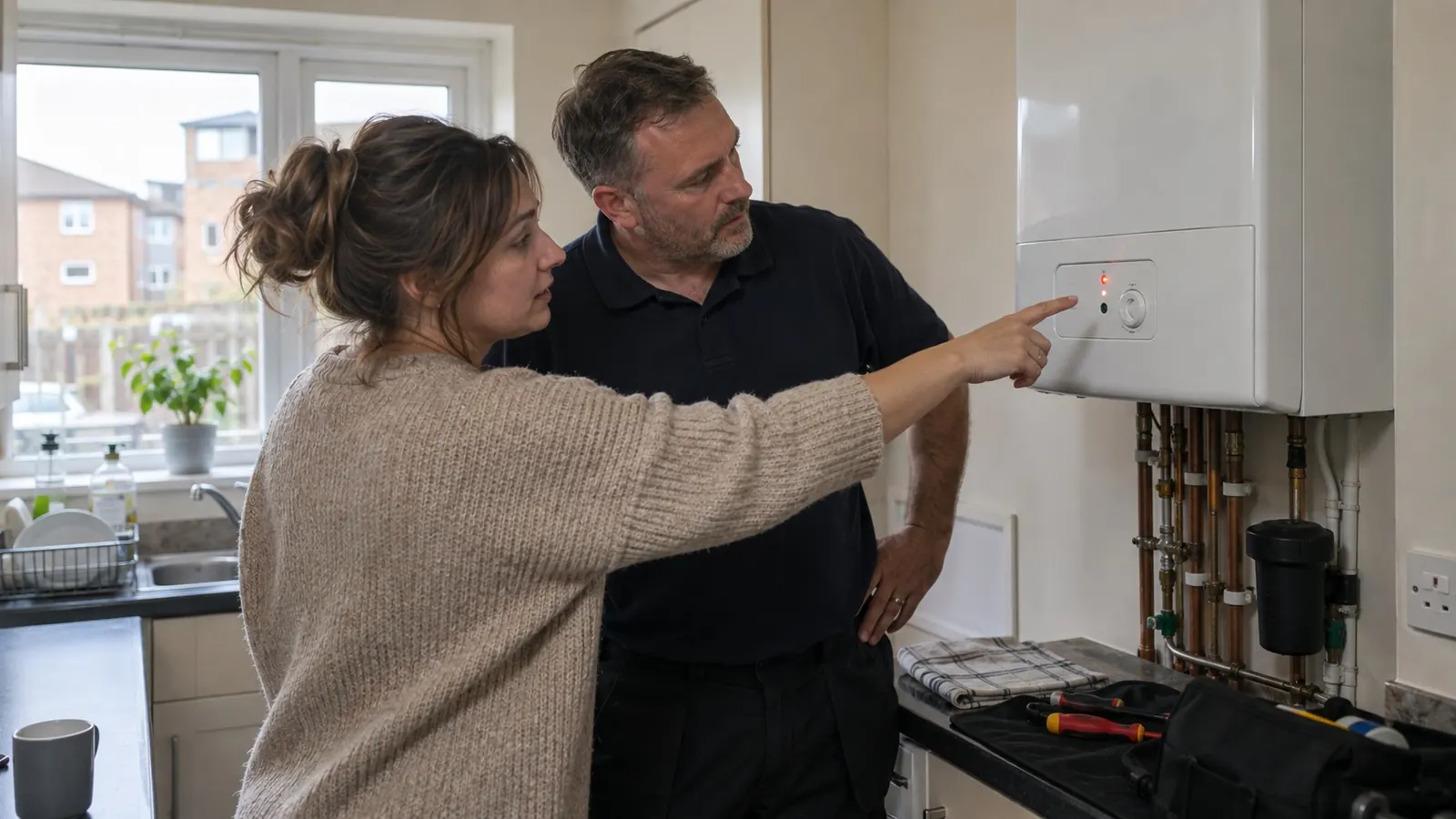
We get this call most weeks. A tenant somewhere in Milton Keynes has a boiler that has stopped and wants to know: do I pay for this, or does my landlord? The law is clearer than most tenancy agreements make it look. This guide separates what the law says from what the small print says, and sets out who is responsible for what.
One thing first: whoever is paying, any work on a gas appliance must be done by a Gas Safe registered engineer. That is not a landlord preference. It is the law, and it protects everyone in the building.
The legal baseline: Section 11
For an assured shorthold tenancy, which covers nearly every private rental in MK, Section 11 of the Landlord and Tenant Act 1985 puts a statutory duty on the landlord to keep in repair and proper working order:
- The structure and exterior of the property.
- The installations for water, gas, electricity and sanitation.
- The installations for space heating and heating water. That is the boiler, the radiators, the cylinder and the controls.
Section 11 cannot be contracted out of. If the tenancy agreement says "the tenant is responsible for boiler repairs", that clause is unenforceable. The landlord remains responsible. This is the single most useful fact for a Milton Keynes tenant to know, and the one most often misunderstood by both sides.
The Homes (Fitness for Human Habitation) Act 2018 adds to this. A property must be fit to live in throughout the tenancy, and a home with no working heating or hot water in winter is not.
What the landlord is responsible for
- Repairing the boiler when it breaks down, at the landlord's cost.
- Replacing the boiler when it reaches the end of its life or cannot economically be repaired.
- Keeping heating and hot water working throughout the tenancy, and acting quickly when they stop.
- The annual gas safety check. Under the Gas Safety (Installation and Use) Regulations 1998, every gas appliance and flue the landlord provides must be checked every twelve months by a Gas Safe registered engineer. A copy of the record (the CP12) goes to the existing tenant within 28 days, to any new tenant before they move in, and the landlord keeps records for two years. The cost sits with the landlord and cannot be passed on.
- Servicing the boiler. Not the same thing as the safety check. Manufacturers require an annual service to keep the warranty, and a serviced boiler breaks down less. Most landlords have both done in one visit. See our gas safety certificate page for how we combine them.
- Responding within a reasonable time. The law does not set a number of hours, but no heating or hot water in cold weather is treated as urgent, and a landlord who leaves a tenant without either for days is exposed to complaints, council enforcement and compensation claims.
What the tenant is responsible for
- Reporting problems promptly, in writing where possible. A small leak that becomes a big one because nobody mentioned it for a month weakens the tenant's position.
- Allowing reasonable access for repairs, servicing and the annual gas safety check, and being in or arranging a key.
- Day-to-day care of the system. Bleeding a radiator, topping up the pressure at the filling loop if it drops below 1 bar, resetting the boiler once after a lockout, not blocking vents or the flue terminal, and not switching the heating off completely in a cold snap.
- Damage they directly caused. Forcing a stuck control and breaking it, drying washing over the flue, pouring water into the casing, tampering inside the boiler, or letting the pipes freeze by leaving the heating off in winter. The bar is clear evidence that the tenant's action caused the fault. Ordinary wear and tear is always the landlord's.
The grey areas
- The boiler broke down six months after the tenant moved in. Landlord. Age and wear do not care about the move-in date.
- The tenant topped the pressure up and it dropped again. Landlord. A boiler that keeps losing pressure has a leak or a failed part. The tenant did the right thing.
- The boiler was never serviced and a fault developed. Landlord. Servicing is the landlord's job.
- The tenant left the heating off, went away, and the pipes froze. Usually the tenant. Landlords may pursue the cost through the deposit, and the deposit scheme will want evidence.
- The tenant fiddled with a radiator valve and now that radiator is cold. Tenant adjusts it back first. If it still will not heat, the landlord investigates, because a seized valve pin is wear, not damage.
- The boiler works but the house never gets warm. Landlord. "Proper working order" means the system can heat the home, not just that a light comes on.
- The tenant wants a smart thermostat. Tenant pays unless the landlord agrees. It is an upgrade, not a repair.
- The tenant did not report a small leak that became a big one. Mostly landlord, because the repair is still theirs, but the failure to report can reduce any compensation the tenant might otherwise claim.
What a tenant can safely do, and what they must not
Fine for a tenant to do, and worth doing before ringing the landlord:
- Bleed a radiator that is cold at the top.
- Top up the pressure at the filling loop if the gauge is below 1 bar, then tell the landlord it dropped.
- Reset the boiler once if it is showing a fault code.
- Check the thermostat and programmer are actually calling for heat, and change the batteries if it has them.
- Check the condensate pipe outside in freezing weather. If it is iced up, pouring warm (not boiling) water along it and resetting the boiler often gets it going.
Must be done by a Gas Safe registered engineer, arranged and paid for by the landlord: anything inside the boiler casing, any fault that comes back after one reset, the annual gas safety check, the service, and a replacement. A tenant should never take the casing off or attempt a repair, and a landlord should never ask them to.
If the landlord will not act
The escalation path for a Milton Keynes tenant is:
- Put it in writing. An email or letter stating the fault, the date it started, and a reasonable deadline. No heating or hot water in winter justifies asking for same-week action.
- Follow up in writing and keep every message.
- Contact Milton Keynes City Council's Environmental Health team if the problem is serious or dragging on. They assess hazards under the Housing Health and Safety Rating System, and a cold home in winter is one. They can issue enforcement notices.
- Use the deposit scheme if you are threatened with deductions for a repair that is the landlord's responsibility. The scheme adjudicates.
- Citizens Advice or a housing solicitor for a dispute that will not settle.
One thing tenants should not do is pay for a landlord repair themselves and hope to claim it back. Pay-and-deduct only works if the landlord has agreed it in writing first. Without that, the money is very hard to recover and the landlord can treat it as rent arrears.
The honest bit for landlords
The cheapest way to run a rental boiler is to look after it. An annual service and safety check in one visit costs less than one emergency call-out in January, keeps the manufacturer warranty alive, and means the engineer already knows the property when something does go wrong. A boiler past fifteen years in a rental is a liability, not an asset. Replacing it on your terms in the summer is cheaper and calmer than replacing it in a cold snap with a tenant threatening the council. If you have several properties in Milton Keynes, a boiler cover arrangement that includes the annual check is worth looking at.
Boiler problems in a Milton Keynes rental
Plumbline MK works with landlords, letting agents and tenants across Milton Keynes, Newport Pagnell, Bletchley, Wolverton, Stony Stratford, Buckingham, Leighton Buzzard and Bedford. We are Gas Safe registered (957816), we can invoice the landlord or agent directly while arranging access with the tenant, and we do the gas safety check and the service in one visit. Get in touch and tell us who you are and what the boiler is doing.
Frequently asked questions
Is the landlord or tenant responsible for boiler repairs? The landlord, under Section 11 of the Landlord and Tenant Act 1985. That duty cannot be moved to the tenant by a clause in the agreement. The only exception is damage the tenant clearly caused.
Can a landlord charge a tenant for a boiler repair? Only where there is clear evidence the tenant caused the damage. Age, wear and lack of servicing are the landlord's. A breakdown shortly after move-in is still the landlord's.
How quickly must a landlord fix a broken boiler? Within a reasonable time, and no heating or hot water in cold weather is urgent. Days, not weeks. If it drags on, put it in writing and involve the council's Environmental Health team.
Who arranges and pays for the annual gas safety certificate? The landlord, every twelve months, using a Gas Safe registered engineer. The tenant's only duty is to allow access. Refusing access without good reason can shift some responsibility if something later goes wrong, so let them in.
Does the tenant have to be home for the safety check? No, but someone has to let the engineer in. Most agents hold keys for exactly this.
Need Professional Advice?
Our Gas Safe registered engineers are ready to help with all your heating needs. Get a free, no-obligation quote today.