Heat Pump Readiness Checklist for Milton Keynes Homes — What to Check Before You Switch
TL;DR
Before committing to a heat pump install in Milton Keynes, work through five readiness checks: insulation level (EPC C or better), radiator sizing (most need upgrading), hot water demand (cylinder space required), electrical capacity (consumer unit suitable for the heat pump), and outdoor space (1.5–2m clearance for the unit). Get all five right and a heat pump works beautifully; get one wrong and you'll be uncomfortable in winter.
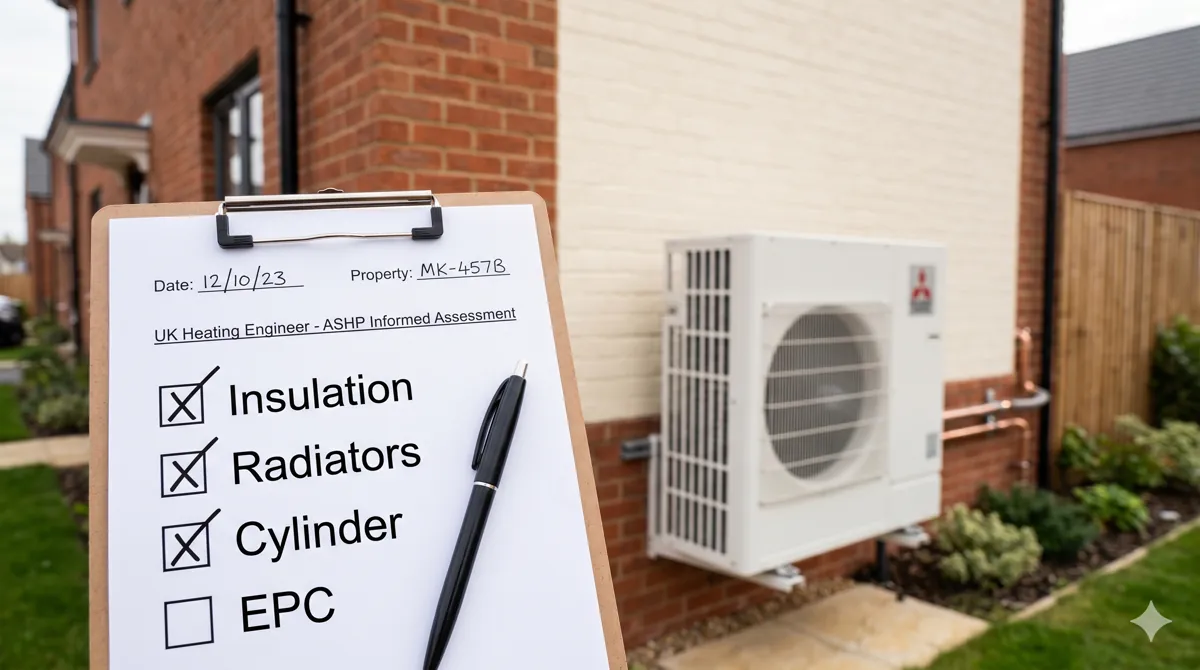
A heat pump comparison post is one thing — actually deciding whether your specific Milton Keynes home is ready for one is another. This guide is the practical pre-flight check — five things to assess about your home before you book a survey, and what to do if you fail one of them.
A quick note before we start: any work on your gas boiler must be carried out by a Gas Safe registered engineer. Heat pump installs require a separate qualification — MCS certification — and many heat pump installers are not Gas Safe registered, and vice versa. The two are different regulated frameworks.
The five readiness checks — overview
| Check | What you're looking for | Failure usually means |
|---|---|---|
| 1. Insulation level | EPC C or better; cavity walls + loft insulation in place | Heat pump runs constantly, never warming the home properly |
| 2. Radiator sizing | Radiators sized for low flow temperatures (45–55°C) | Cold rooms in deep winter; usually fixable by upgrading |
| 3. Hot water demand | Space for a 200–300 litre cylinder | No hot water on demand; need to plan around showers |
| 4. Electrical capacity | Consumer unit can take a 32A circuit | Consumer unit upgrade needed (£400–£900) |
| 5. Outdoor space | Wall or ground space, 1.5–2m clearance | Visual / planning constraints; sometimes solvable |
Pass all five and you're in the green zone for a straightforward install. Fail one, you've usually got a fixable issue. Fail two or more, the economics start to tip toward a high-efficiency gas boiler instead.
Check 1 — Insulation
This is the single most important check. Heat pumps deliver heat at lower flow temperatures than gas boilers (typically 35–55°C versus 65–80°C). That works fine in a well-insulated home but fails in a leaky one — the heat escapes faster than the heat pump can replace it.
What to look at
- EPC rating. Aim for C or better. Most Milton Keynes homes built post-1990 are at C; older properties around Stony Stratford, Newport Pagnell or Bletchley may be D or E.
- Cavity wall insulation. Most MK homes built between 1930 and 2000 have cavity walls. Are they insulated? Usually visible from the EPC report.
- Loft insulation. Current standard is 270mm. Anything below 200mm is a problem.
- Window glazing. Modern double or triple glazing throughout. Old single-glazed windows will undermine heat pump performance.
- Draughts. Stand by external doors on a windy day — can you feel air movement? That's heat escaping.
Failure path
If your EPC is below C, address the cheapest insulation upgrades first — usually loft insulation and cavity walls if not already done. The Boiler Upgrade Scheme generally requires outstanding EPC recommendations to be addressed before approval, so this work is often a prerequisite anyway.
Check 2 — Radiator sizing
Heat pumps move more water around the system at a lower temperature than gas boilers. Radiators sized for 70°C flow may be too small to deliver the same heat output at 50°C.
What to look at
- How many panel radiators do you have? Type 21 (double panel, single fin) and Type 22 (double panel, double fin) work better than Type 11 (single panel).
- Are radiators large for the rooms they're in? A heat pump install survey will calculate room-by-room, but as a rough check: a typical 4m x 4m living room needs around 2,000W of heat output at 50°C flow — significantly more than the same room would need at 70°C flow.
- Microbore pipework. Some MK 1980s-90s installations used 8–10mm microbore pipework which restricts flow at heat pump temperatures. May need re-piping.
Failure path
Most homes need 2–4 radiator upgrades — typically swapping smaller Type 11s in living areas for Type 22s, or going to slimmer-profile high-output radiators in tight spaces. Cost: £150–£280 per radiator including labour. Factor this into the total install budget.
Check 3 — Hot water demand
Heat pumps don't heat water on demand the way combis do. You need a hot water cylinder — typically 200–300 litres — and that cylinder needs space.
What to look at
- Existing setup. If you have a combi, you'll need to find space for a new cylinder (airing cupboard, garage, utility room).
- Cylinder size needed. Roughly 50 litres per occupant is a reasonable rule of thumb. A 4-person household typically needs 200–250 litres.
- Reheat time. Heat pump cylinders reheat over 1–3 hours rather than minutes — fine for normal usage patterns but means you need to think about when high-demand events (back-to-back showers) happen.
Failure path
If your home has no realistic place for a 200L+ cylinder, a heat pump may not be viable without significant compromise. Some smaller homes use a thermal store or a 150L cylinder with limitations on hot water availability. We'd flag this on a survey.
Check 4 — Electrical capacity
Heat pumps draw significant electrical current — typically 16–32A on a dedicated circuit. Older Milton Keynes homes (particularly 1960s/70s estates in Fishermead, Netherfield) may have consumer units that can't accommodate this without upgrade.
What to look at
- Consumer unit age. Modern 18th Edition compliant units (post-2018) are usually fine. Older units with rewireable fuses or pre-RCD designs typically need upgrading.
- Spare ways. Is there a spare circuit position in the consumer unit, or is it full?
- Mains supply size. Most Milton Keynes homes have a 60A or 80A main supply — adequate for a heat pump alongside normal household load. Properties with electric showers and electric ovens on a 60A supply may need an uplift.
Failure path
Consumer unit upgrade is £400–£900. Mains supply upgrade (very rare) is £600–£1,500 plus DNO charges. These costs aren't covered by the BUS grant, so factor them in.
Check 5 — Outdoor space
Air-source heat pumps need outdoor units. They're around the size of a large washing machine and need clearance for airflow.
What to look at
- Clearance. 1.5–2m clear in front of the unit, 0.5m at the sides, 0.3m behind.
- Mounting surface. Solid wall (cavity wall is fine), or a concrete pad on the ground.
- Distance from boundaries. Ideally not within 1m of a neighbouring property boundary (planning permission becomes an issue otherwise).
- Noise considerations. Modern heat pumps are quiet (40–45 dB at 1m) but you don't want one directly outside a bedroom window.
- Pipe routing. Refrigerant lines need to run from the outdoor unit to the indoor cylinder/controls. Shorter and straighter runs are cheaper.
Failure path
Tight or shared boundaries sometimes mean a heat pump is technically possible but socially difficult. Gardens with limited access for delivery and install can add £300–£600 to the install cost.
Worth knowing: Permitted Development rules in 2026 allow a domestic heat pump unit up to 1.5m³ in volume to be installed without planning permission, provided certain noise and boundary conditions are met. For most installations this is a non-issue, but listed buildings and conservation areas (parts of Stony Stratford, Olney) need permission regardless.
What if I fail two or more checks?
The economics tip toward staying with gas. A modern high-efficiency boiler — Worcester Greenstar Lifestyle, Vaillant ecoTEC plus, Ideal Vogue Max — runs at 92–94% efficiency and delivers 10–12 years of reliable service for a £2,000–£3,000 install cost. Compared to a £6,000–£10,000 heat pump install on a borderline-suitable home, the gas option often wins on lifetime cost and comfort.
The cleaner approach: address the failed checks first (insulation, radiators), wait 2–3 years, and reassess.
DIY vs call an MCS-certified surveyor
Fine to do yourself:
- Check your current EPC rating online
- Walk around and assess insulation, draughts, radiator sizes
- Photograph your consumer unit and outdoor space
- Look up Permitted Development rules for your address
Leave it to an MCS-certified installer:
- Heat loss calculations (room-by-room)
- Radiator sizing for low flow temperatures
- Detailed electrical capacity assessment
- BUS grant application
Plumbline MK provides initial readiness consultations across Milton Keynes and surrounding towns including Towcester, Newport Pagnell, Bletchley, Wolverton, Stony Stratford and Olney. We work with MCS-certified partners for the actual heat pump install, and quote the gas alternative on the same survey so you can compare both options.
The team is Gas Safe registered (#957816). Call 07805 844 016 for a heating-options consultation.
Need expert help? Contact Plumbline MK for a free, no-obligation quote. Call 07805 844 016 for same-day response across Milton Keynes and surrounding areas.
Frequently Asked Questions
Is my Milton Keynes home suitable for a heat pump?
Most Milton Keynes homes built after 1990 with EPC ratings of C or better are technically suitable for an air-source heat pump, though many need 2–4 radiator upgrades and cylinder space identified. Older properties (pre-1990, EPC D or below) typically need insulation work first to achieve good heat pump performance. The five readiness checks are: insulation level, radiator sizing, hot water cylinder space, electrical capacity, and outdoor space. Pass all five and the install is straightforward. Fail two or more and a high-efficiency gas boiler usually makes more economic sense than a heat pump on a borderline-suitable home.
What insulation do I need before a heat pump install?
Aim for an EPC rating of C or better. Specifically: cavity wall insulation if your home has cavity walls (most MK homes built 1930–2000 do), at least 270mm of loft insulation, and modern double or triple glazing throughout. The Boiler Upgrade Scheme generally requires any outstanding EPC insulation recommendations to be addressed before grant approval. Older Milton Keynes properties around Stony Stratford and Newport Pagnell often need cavity wall insulation upgraded as a prerequisite. Spending £600–£1,500 on insulation before a heat pump install is usually money well spent — both for grant eligibility and for actual comfort.
Will I need new radiators for a heat pump?
Probably some, but not all. Heat pumps run at lower flow temperatures (45–55°C vs 70°C+ for gas boilers), so radiators need to be larger to deliver the same heat. A typical Milton Keynes home needs 2–4 radiators upgraded — usually the larger living spaces where the original radiators are sized for 70°C flow. Cost: £150–£280 per radiator including labour. Slimmer high-output radiators or low-profile vertical designs can fit in tight spaces. A proper MCS heat-loss survey will identify exactly which radiators need upgrading rather than recommending a blanket replacement.
How much outdoor space does a heat pump need in Milton Keynes?
An air-source heat pump outdoor unit needs roughly 1.5–2m clearance in front for airflow, 0.5m at each side, and 0.3m behind. The unit itself is about the size of a large washing machine. It can be wall-mounted or ground-mounted on a concrete pad. Ideally site it more than 1m from the neighbouring boundary to avoid planning issues, and not directly outside bedroom windows. Modern units are quiet (40–45 dB at 1m). Permitted Development rules in 2026 allow most domestic heat pumps without planning permission, but listed buildings and conservation areas (parts of Stony Stratford and Olney) still need consent.
Need Professional Advice?
Our Gas Safe registered engineers are ready to help with all your heating needs. Get a free, no-obligation quote today.