Combi, System or Conventional Boiler? How to Choose the Right One for Your Milton Keynes Home
TL;DR
Combi boilers suit 1–3 bed homes with one bathroom (<strong>£1,800–£3,200</strong>). System boilers suit 3–5 bed homes with multiple bathrooms (<strong>£2,000–£3,800</strong>). Conventional boilers suit older/larger homes with low mains pressure (<strong>£2,200–£4,000</strong>). Always get your mains flow rate tested before choosing.
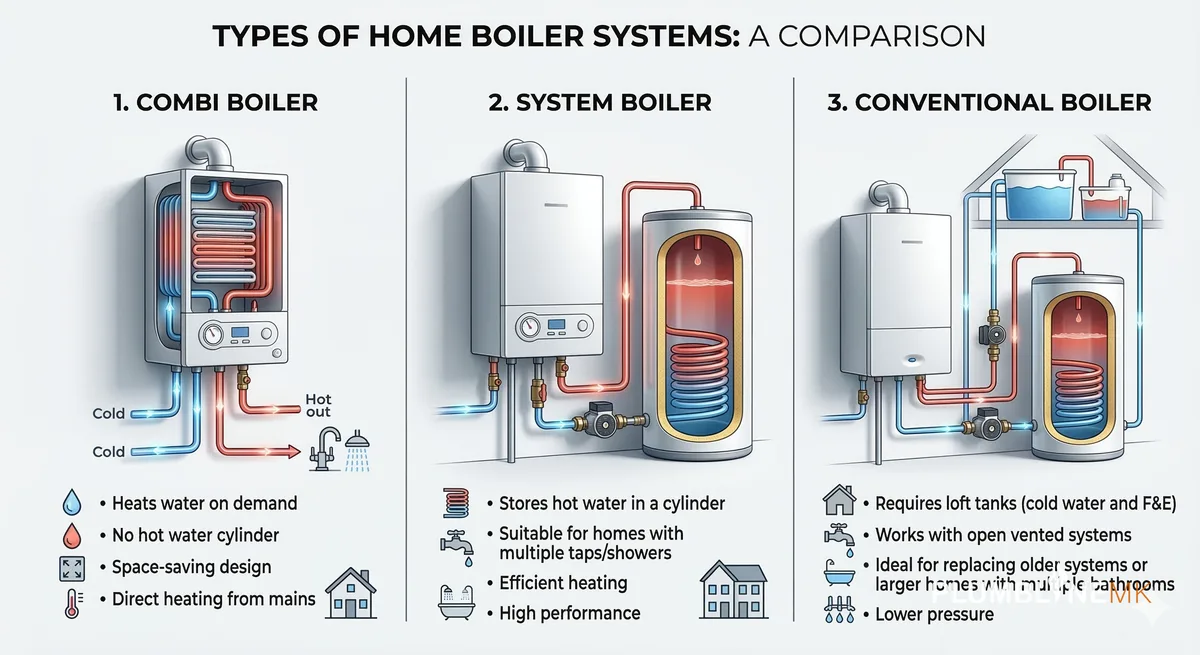
One of the most common questions we get from Milton Keynes homeowners before a boiler replacement is: "Should I stick with the same type, or is there a better option for my home?" It's a good question. The right boiler type genuinely depends on your property, your household size, and your hot water usage — and switching types can either make a significant improvement or cause problems if you choose wrong.
This guide breaks down all three types, gives you a clear comparison table, maps each type to the kinds of MK properties they suit best, and covers conversion costs if you're thinking about switching.
The Three Boiler Types Explained
Combi Boiler (Combination Boiler)
A combi boiler heats water on demand directly from the mains. It provides both central heating and hot water from a single unit, with no need for a separate hot water cylinder or cold water storage tank. Hot water is available almost instantly at the tap.
Pros:
- Compact — no cylinder or tank means significant space savings
- Hot water on demand — no waiting for a tank to reheat
- Energy efficient — only heats water when you need it
- Cheaper to install than system or conventional in most like-for-like swaps
- Lower standing heat losses (no cylinder losing heat all day)
Cons:
- Hot water flow rate is limited by mains pressure — poor in low-pressure areas
- Cannot supply two hot water outlets simultaneously at full pressure
- Not ideal for homes with multiple bathrooms in heavy use at the same time
- Mains pressure must be adequate — typically 1.5 bar or above at the stopcock
System Boiler
A system boiler heats water and stores it in a hot water cylinder. It takes cold water directly from the mains (no loft tank required) and uses a sealed, pressurised system. Multiple outlets can draw hot water simultaneously from the cylinder.
Pros:
- Can supply multiple bathrooms simultaneously
- Good flow rates from stored cylinder
- Works well in homes with 3+ bedrooms and 2+ bathrooms
- No loft tank required (unlike conventional)
- Better suited to solar thermal and heat pump integration
Cons:
- Requires space for a hot water cylinder (typically airing cupboard)
- Hot water can run out if the cylinder is depleted during high-demand periods
- Slightly higher installation cost than combi
- Cylinder loses some standing heat over time
Conventional (Regular) Boiler
Also called a heat-only or regular boiler, a conventional system requires both a hot water cylinder (typically in an airing cupboard) and a cold water storage tank (typically in the loft). It is the oldest of the three types and is found in many older MK properties.
Pros:
- Works well with low mains water pressure (gravity-fed hot water)
- Can supply multiple bathrooms even in low-pressure areas
- Compatible with older, larger heating systems
- The cold water tank acts as a buffer for homes with intermittent mains supply
Cons:
- Requires the most space — cylinder, loft tank, and pipework
- Loft tanks can freeze in cold weather
- Highest installation cost
- Hot water pressure is lower (gravity-fed unless a pump is added)
- More components means more potential failure points
Quick Comparison Table
| Feature | Combi | System | Conventional |
|---|---|---|---|
| Hot water cylinder needed | No | Yes | Yes |
| Loft cold water tank needed | No | No | Yes |
| Best for number of bathrooms | 1 | 2–3 | 2–4 |
| Works with low mains pressure | No | Partial | Yes |
| Hot water on demand | Yes | No (stored) | No (stored) |
| Typical installed cost (MK, 2026) | £1,800–£3,200 | £2,000–£3,800 | £2,200–£4,000 |
| Heat pump compatibility | Limited | Good | Good |
Which Boiler Type Suits Your Milton Keynes Property?
New builds and modern estates (Broughton, Tattenhoe, Brooklands)
Most new MK builds were designed with combi boilers in mind. If you have good mains pressure, a 1–3 bed home, and one or two bathrooms, a combi boiler is almost certainly the right choice for like-for-like replacement.
Larger semis and detached (Furzton, Shenley, Walnut Tree)
3–4 bed semis with two bathrooms often benefit from a system boiler if hot water demand is high. If multiple family members shower at peak times, a stored cylinder provides better simultaneous flow than a combi.
Older properties and period homes (Newport Pagnell, Olney, Woburn Sands)
Older properties with lower mains pressure or larger radiator systems may be better served by a conventional boiler replacement or a system boiler with a well-sized cylinder. Don't automatically switch to a combi in a period property without having your mains pressure tested first.
Flats and small apartments
Combi boilers are almost always the right choice for flats and small apartments — space is at a premium and a single bathroom means demand is manageable.
Converting Between Boiler Types: Costs
| Conversion Type | Typical Extra Cost Over Like-for-Like | Notes |
|---|---|---|
| Conventional to combi | +£500–£1,500 | Cylinder and tank removal, pipe capping, mains pressure upgrade may be needed |
| Conventional to system | +£300–£800 | Tank removal, new pressurised cylinder, mains feed to cylinder |
| Combi to system | +£400–£1,000 | Cylinder installation, pipework reconfiguration |
| System to combi | +£300–£700 | Cylinder removal or repurposing, pipework changes |
Future-Proofing: Which Type Works Best With Heat Pumps?
If you're thinking about eventually switching to a heat pump, your choice of boiler type today affects how straightforward that transition will be. Heat pumps require a hot water cylinder — they cannot work like a combi. A system or conventional boiler with an existing cylinder is therefore easier to transition from.
That said, there is no gas boiler ban for existing homes in 2026. See our full guide on heat pumps vs gas boilers for an honest assessment of whether a heat pump is worth considering for your property now.
If you're installing a new combi boiler today and think you might want a heat pump in 5–10 years, the conversion cost at that point is manageable. Don't let future heat pump compatibility alone drive you to a system boiler if a combi otherwise suits your home perfectly.
Getting the Right Boiler in Milton Keynes
At Plumbline MK, we always carry out a mains flow rate test before recommending a boiler type. This is a simple test that takes minutes but is fundamental to making the right choice — particularly if you're considering a combi boiler. We survey every job before quoting, and we'll give you an honest recommendation based on your property, not on which boiler earns us more margin.
Call us on 07805 844 016 or get in touch to arrange a free survey and quote.
Frequently Asked Questions
Is it always worth converting from a conventional boiler to a combi?
Not always. Conversion makes sense if you want to free up the space occupied by the cylinder and tank, your mains pressure is good, and you have one bathroom. If you have two bathrooms used simultaneously, low mains pressure, or a large radiator system, a system boiler is often a better outcome and less disruptive to install. Always get a mains pressure test first.
How do I know what size boiler I need?
Boiler size is measured in kilowatts (kW) and should be calculated based on your home's heat loss — the number and size of rooms, insulation quality, window type, and how many bathrooms need hot water. A common rule of thumb is 1.5kW per radiator for central heating plus 5–10kW for hot water, but a proper heat loss calculation by a qualified engineer is always more accurate.
Are combi boilers cheaper to run than system or conventional boilers?
In most households, yes — combis are slightly cheaper to run because they heat water on demand rather than storing it in a cylinder (which loses heat constantly). However, for large households with high hot water demand, a well-insulated system boiler cylinder can be comparable in running cost. The efficiency gap between modern boiler types is relatively small compared to the efficiency difference between any modern boiler and a 15-year-old system.
Need Professional Advice?
Our Gas Safe registered engineers are ready to help with all your heating needs. Get a free, no-obligation quote today.