Replacing a Boiler in Great Linford: What a 1970s Milton Keynes House Needs
TL;DR
Most of Great Linford was built in the 1970s and early 1980s, so a boiler replacement there is rarely a straight swap. The survey checks the gas pipe size, whether the system is open vented with a tank in the loft, the pipework under the floors, where the old flue goes and whether any of the original heating parts might contain asbestos. Any replacement must be a condensing boiler under the Building Regulations, fitted and notified by a Gas Safe registered engineer.
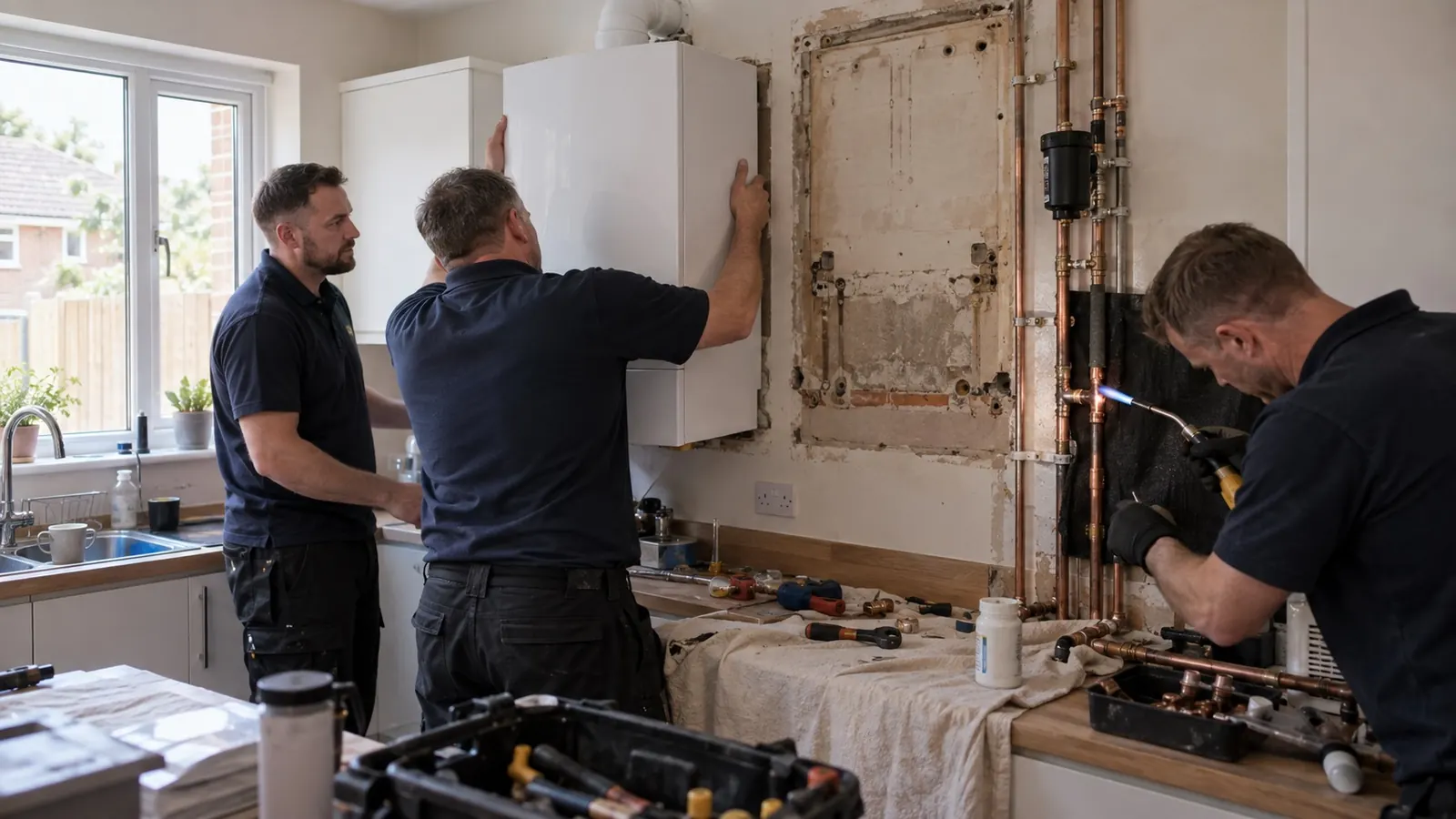
Great Linford is two places with one name: the old village by the Grand Union Canal, with St Andrew's church, the almshouses and the manor house, and the grid square that grew up around it when Milton Keynes was built. The census tells the story plainly: the parish had 263 people in 1971 and 11,882 in 1981. Most of that housing went up in a single decade, and it is the housing stock this page is about.
A house built in the 1970s does not get the same installation as a new build on the other side of the city. This page covers what our survey looks at in a Great Linford house, what adds work to the job, and the parts of the decision quote-by-phone firms skip.
Where Great Linford houses are in their heating life
A house built in 1975 has almost certainly had its boiler replaced at least once. Across the parish, from Great Linford itself out to Giffard Park, Blakelands, Neath Hill, Pennyland, Downs Barn and Downhead Park, the pattern is roughly this:
- The original system. A floor-standing or wall-hung boiler, an open-vented heating circuit with a feed and expansion tank in the loft, and a copper hot water cylinder in an airing cupboard. Some houses had a back boiler behind a gas fire in the living room.
- The first replacement. Typically in the 1990s or early 2000s, often a like-for-like swap that kept the loft tank and the cylinder. Some were fitted before condensing boilers became the rule in 2005.
- The second replacement. Usually the point at which a household considers a combi. It is the job that needs the most thought, because it changes the system rather than just the box on the wall. The rest of this page is written for it.
What the survey checks in a 1970s house
A proper survey takes under an hour and it is why we do not quote over the phone. These are the things that decide how the job goes.
- The gas supply. Older houses often have a gas run sized for the original boiler and a gas fire. A modern combi needs a higher gas rate, and the manufacturer's installation instructions set out the pipe size and pressure drop that must be achieved. If the existing pipe cannot deliver it, part of the run is upsized, sometimes with a new route from the meter.
- Open vented or sealed. If your loft still has a small tank next to the big cold water tank, your heating is open vented. Converting to a sealed system or a combi means removing that tank and checking the rest of the system can hold pressure. Old valves and joints that were fine at low pressure sometimes weep once pressurised, and a survey should say so before the job, not after.
- The pipework. Some houses from this era have microbore pipe to the radiators, and some have pipe buried in a solid ground floor. Neither stops the job, but both change what a system clean can achieve and how a leak would be dealt with later.
- The flue route. A back boiler used the chimney. A 1990s boiler may have a flue through a wall in a position that would not be allowed today. Approved Document J of the Building Regulations sets the distances a flue terminal must keep from windows, doors, boundaries and the ground, and a new boiler has to meet them even if the old one did not. That can mean a new flue position, a longer run or a plume kit, and occasionally it rules out the cupboard the old boiler was in.
- Asbestos. The Health and Safety Executive's guidance is that any building built or refurbished before 2000 may contain asbestos, and it lists asbestos cement flue pipes, lagging on pipes and boilers, and water tanks among the places it is found. In a Great Linford house that has not been fully modernised, the old flue, a boiler casing panel or the back boiler surround are the parts we look at. If there is any doubt, that material is not touched until it has been dealt with properly, and it is priced as a separate item.
- The hot water demand. A three-bedroom house with one bathroom is a natural combi conversion. Add a second bathroom or a family that showers at the same time and a system boiler with an unvented cylinder may serve you better.
- The incoming mains. A combi is only as good as the flow and pressure arriving from the street, so we measure it. If the mains into the house is weak, a combi will give you a worse shower than the cylinder you have now.
What changes the price
We do not publish installation prices, because two houses on the same road in Great Linford come out very differently once you look inside. A written quote is built from:
- The type of job. A like-for-like swap on a sealed system is the simplest. A conversion from open vented to combi, or moving the boiler from a cupboard to a wall that suits the flue, is more time and more materials.
- The boiler model and output, sized to the house and the hot water demand rather than to the biggest number on the box.
- Gas pipe upgrades, if the survey finds the run is undersized.
- The flue: a straight run through an outside wall, or a longer or vertical route to meet the terminal position rules.
- System cleaning. A fifty-year-old system carries fifty years of sludge unless it has been flushed. A cleanse or a powerflush is decided on what comes out when the system is drained, not assumed either way.
- Water treatment. Milton Keynes is a hard water area on Anglian Water's own hardness map, and the warranty terms of the boilers we fit expect a filter on the return and protection against scale.
- Anything the survey cannot see. Pipe under a concrete floor or material that needs testing is discussed and priced before it is touched, not added to the bill afterwards.
The paperwork a Great Linford homeowner should end up with
Under the Building Regulations a replacement boiler has to be a condensing model, and the installation is notifiable. Gas Safe Register sets out what should happen: the engineer commissions the appliance, fills in the Benchmark checklist in the boiler's logbook, registers the manufacturer's warranty and notifies the local authority through the Register, after which you receive a Building Regulations compliance certificate. Keep it with the deeds; solicitors ask for it when a house is sold. Ask to see the engineer's Gas Safe ID card before the job starts and check the back of it for boilers.
The honest bit
Two things a firm that sells boilers for a living tends not to say. If your boiler is a condensing model from the mid-2000s onward and it has failed on one part, a repair is usually the better decision; age alone is not a reason to replace a boiler that is serviced and has parts available. And a combi is not automatically the upgrade in a house of this age. With poor mains flow or two bathrooms in regular use, keeping a cylinder and fitting a system boiler gives better hot water than the combi the last salesperson recommended. The answer comes out of the survey, not the brochure.
The old village is different again
The historic core around the High Street, the church and Great Linford Manor Park is a different proposition. The parish has four Grade II* listed buildings and twenty more at Grade II, and the older cottages have solid walls, old chimneys and limits on where a flue can appear. None of that stops a boiler being replaced, but the survey takes longer and the flue route needs more care. If your house is one of them, say so when you book.
Booking a survey in Great Linford
We are based at Grange Farm on the west side of Milton Keynes, a short drive up the grid roads to MK14, and we work in Wolverton, Newport Pagnell and the estates between them most weeks. The survey is free and you get a written, itemised quote afterwards rather than a number on the doorstep.
Second replacement in a 1970s semi, combi conversion on an open-vented system or a cottage by the canal: tell us what you have and we will tell you plainly what it needs. Read about our boiler installation service, or get in touch to book a visit.
Sources
- Great Linford, Wikipedia (parish population 263 in 1971 and 11,882 in 1981, from the census; districts in the parish; listed buildings)
- Health and Safety Executive, Asbestos FAQs (buildings built or refurbished before 2000; where asbestos is typically found)
- Building Regulations, Approved Document J and Approved Document L
- Gas Safe Register, New gas appliance installation
- Anglian Water, Water hardness
- The Parks Trust, Great Linford Manor Park
Need Professional Advice?
Our Gas Safe registered engineers are ready to help with all your heating needs. Get a free, no-obligation quote today.